Reporting snapshot · 30 October 2026 (Asia/Karachi). The figures below come from the petroleum minister's written reply to the National Assembly and from Planning Minister Ahsan Iqbal's remarks to reporters on 29 October; the written reply has not been published in full. The main limitation is that the joint committee has no published terms of reference, so the size, timing and financing of any phased reduction are unknown.
What the government put on the record
Pakistan’s government has ruled out cutting the petroleum levy now, and has told the National Assembly how much the levy raises. On Thursday, 29 October, Planning Minister Ahsan Iqbal said the government would not reduce the levy “under any pressure from Jamaat-e-Islami” and that a phased decrease would instead be considered from the next budget, The Express Tribune reported.
The same day, Petroleum Minister Ali Pervaiz answered a question in the National Assembly with a written reply setting out the ledger. Levy collections from 2022-23 to 2025-26 totalled Rs4.4 trillion against a cumulative target of about Rs4.2 trillion, Profit by Pakistan Today reported — Rs227 billion more than planned. In the last completed year, provisional collection was Rs1.567 trillion against a target of Rs1.468 trillion, and the budget estimate for the current year is Rs1.676 trillion.
Two things are new. The size of the levy is now a matter of parliamentary record rather than of competing claims, and the government has tied it explicitly to the International Monetary Fund: the petroleum levy collection “is also part of the fiscal targets agreed under the IMF Extended Fund Facility”, the minister told the assembly.
What has not changed is the vehicle. KhabarWire reported on 28 October that the government and Jamaat-e-Islami had agreed a six-member committee — Deputy Prime Minister Ishaq Dar, Planning Minister Ahsan Iqbal and Rana Sanaullah for the government, three party nominees — to widen the fuel relief scheme and prepare proposals for phasing out the levy. The committee is still that committee. What is new is the arithmetic it must work within, and the timetable attached to it: the next budget. The campaign is tracked in the Jamaat-e-Islami petroleum levy file.
How large the levy has become
On a litre of petrol the government now collects Rs80 in petroleum levy and Rs5 in climate levy on top of Rs20.56 of customs duty — about Rs106 in tax before any part of the base price, The Express Tribune reported. That is why the levy, rather than the crude price, is the line Jamaat-e-Islami has organised against, and why KhabarWire’s account of the 30 October prices finds Rs85 of levy inside a Rs400.67 litre of diesel and a Rs377.91 litre of petrol. The regulator’s price publications list records the publication effective 30 October, and the levy line did not move.
The relief scheme is the other side of the coin. Iqbal said about 12.7 million people have registered for the government’s discount on motorcycles, three-wheelers and cars with engines up to 800cc. That scheme is a budget cost rather than a revenue measure, so every rupee not collected in levy has to be funded.
Iqbal framed the choice as a matter of timing rather than principle. “Pakistan’s current macroeconomic situation, which we have managed with great difficulty, cannot afford a repetition of the mistakes of the past,” he said, adding that countries around the world were taking precautionary measures against the same shocks and that decisions taken for “temporary public applause” today could become a crisis tomorrow. In the same week, Radio Pakistan reported Ahsan Iqbal saying that scrutiny of development projects had saved Rs7 billion in the previous month, Rs14.5 billion cumulatively in the first quarter, and that monthly inflation had eased to 10.3 per cent from 11.1 per cent in August.
The proposal the government did not adopt
The most revealing figure in the day’s proceedings was not the committee announcement but the minister’s own recommendation from May. Ali Pervaiz had written to the finance minister asking for the annual collection target to be fixed at Rs1 trillion and the rate cut to Rs50 per litre, because of high global oil prices. The government did not adopt that proposal, Profit by Pakistan Today reported.
The distance between the two numbers is the whole argument. The minister proposed a Rs1 trillion target; the budget now estimates Rs1.676 trillion for the current year, 68 per cent higher, and the rate remained at Rs80 a litre through a period when global oil prices rose sharply. A phased reduction from the next budget is the first time the government has attached a vehicle to the levy, and the first time there is a published number against which a future cut can be measured.
The power sector is asking for something different
While the government was defending the levy, the electricity industry was arguing in another forum to have part of it removed. At a public hearing held by the National Electric Power Regulatory Authority on Thursday, the Power Division and industry representatives asked for the removal or reduction of petroleum levies on furnace oil and high-speed diesel used for generation, Profit by Pakistan Today reported.
Industrial representatives put the levy on furnace oil at about Rs76,000 a tonne and the diesel levy at Rs80 a litre, and said the taxes add roughly Rs10 per unit to generation costs; removing them would cut the cost of a unit from about Rs62 to between Rs44 and Rs50. Entities operating under the Power Division said furnace oil and diesel supplied 3.6 per cent of September’s generation because liquefied natural gas and cheaper fuels were unavailable, and industrial representatives argued that the levies enlarge the power sector’s subsidy bill. Naveed Qaiser, chief financial officer of the Power Planning and Monitoring Company, said the levies were having a substantial effect on generation costs and that the Power Division had been pursuing their removal at government forums.
Three constituencies now want the levy changed in three ways: Jamaat-e-Islami wants it abolished outright, the government has offered a phased reduction from the next budget, and the power industry wants it taken off the fuels that keep the lights on. None has secured the first rupee.
What sits behind the pumps
The same reply set out where the fuel comes from. For September 2026, projected petrol demand was about 692,000 tonnes against domestic refinery availability of 262,000 tonnes, with about 511,000 tonnes of imports planned. On 22 September, petrol stocks stood at about 395,000 tonnes, with another 56,000 tonnes at berth and 55,000 tonnes at outer anchorage in Pakistani waters — roughly 506,000 tonnes, which the minister said covered about 22 days at average daily sales of 22,500 tonnes. High-speed diesel stocks stood at about 568,000 tonnes, close to 30 days of cover, with no imports planned for the month.
Money owed to oil marketing companies is the other side of the ledger. Of Rs120.3 billion in price differential claims, Rs53.8 billion had been disbursed and Rs66.5 billion remained outstanding, the minister said, with the rest released only after audit by an auditor appointed by the regulator.
What is still uncertain
No cut has been agreed, and no rate, date or volume is on the table. The government has ruled out an immediate reduction and tied a phased one to the next budget; the committee formed to prepare proposals has no published terms of reference, meeting date or deadline.
The budget estimate of Rs1.676 trillion assumes the current rate holds; if the levy is reduced, that gap has to be closed by something else, and the government has not said what.
The stock figures are for September and the demand figures are projections, so they describe the position entering the current month rather than now. A 22-day petrol cover is not thin, but it is not long.
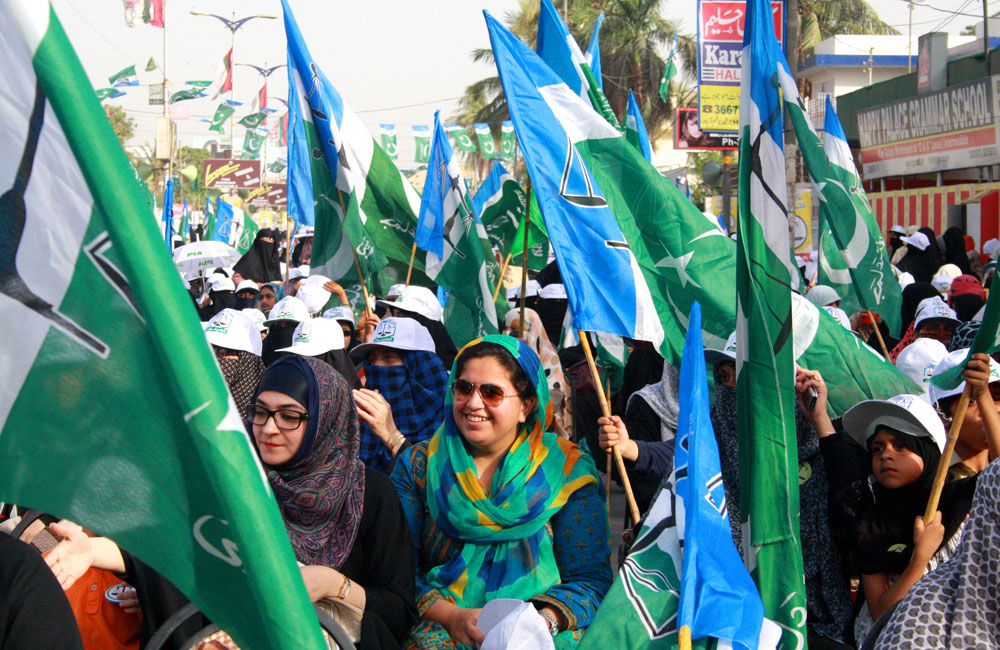
And the party’s deadline is running. Business Recorder reported that Liaqat Baloch, chairing a consultative meeting of Jamaat-e-Islami in Mansoorah on Thursday, warned that the party would launch a long march from Multan towards Islamabad in mid-November if the government did not provide relief within the 10-day window the prime minister had sought. The meeting decided to hold rallies in Quetta, Mirpur Khas, Bahawalpur, Mansehra and Sargodha first, and formed committees on transport, medical aid, security, logistics and media. The march itself was set by the party’s chief on 27 October, as KhabarWire reported at the time.