Reporting snapshot · 14 November 2026 (Asia/Karachi). The account rests on the Inter Services Public Relations release published on 14 November and on the statements the presidency, the prime minister's office and the interior ministry issued afterwards. No independent account of the fighting has been published, the military has not said whether the toll it announced on 13 November is revised, and the operation was still under way when the announcement was made.

Pakistan’s military said on Saturday, 14 November, that two of its soldiers were killed and 16 militants died in intelligence-based operations in North Waziristan district, Khyber Pakhtunkhwa. The Inter Services Public Relations (ISPR), the armed forces’ media wing, said 12 of the fighters it calls Khwarij were killed at Ali Khel and two each at Mir Ali and Datta Khel, and that two of those killed at Ali Khel were Afghan nationals. It was the first announcement in the running operation at Mir Ali to report Pakistani military losses, according to Radio Pakistan, which carried the release together with the statements from the presidency and the prime minister’s office, and the Associated Press of Pakistan.
What separates Saturday’s statement from the one that preceded it is the two names. On 13 November the same military wing announced that 74 militants had been killed across Khyber Pakhtunkhwa and Balochistan, 43 of them in Mir Ali and Orakzai over a 48-hour window, and that release recorded no security-force losses either way. The statement published on Saturday counts a separate twelve-hour phase of the same campaign, and for the first time names the Pakistani soldiers killed in it: Havildar Asmat Ali, 43, of Swabi district, and Naik Aftab Ali, 32, of Mardan district. The Express Tribune reported the announcement and Geo News published it alongside figures on the wider violence in the province, while KhabarWire covered the 13 November figures as they were announced.
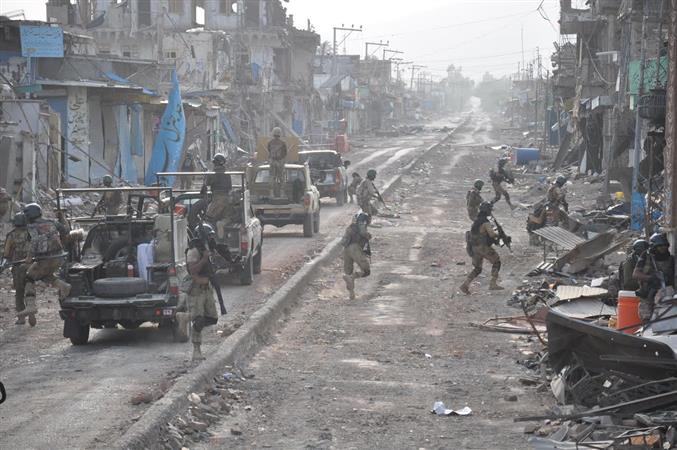
The military’s account of Saturday’s engagements is brief. It said that in the last twelve hours, after what it called fierce fire exchanges, 12 Khwarij were killed in Ali Khel, two each in Mir Ali and Datta Khel, and that weapons and ammunition were recovered from the dead, who it said had been involved in killing civilians. It described the operation as a continuation of the intelligence-based operations being conducted in the area and said sanitisation operations would continue to clear what it calls “holed-up” Khwarij, under the Azm-e-Istehkam campaign that the Federal Apex Committee approved under the National Action Plan.
Havildar Asmat Ali and Naik Aftab Ali
The release names two soldiers and gives their ages and home districts: Havildar Asmat Ali, 43, a resident of Swabi, and Naik Aftab Ali, 32, a resident of Mardan. It says both fought gallantly before being killed, and it stops there. There is no unit, no date of death inside the twelve hours, and no account of how either man died. The elaboration came from the political statements, and it is commemorative rather than operational.
Three statements, one message
President Asif Ali Zardari said the nation saluted its brave sons, that the sacrifices of Havildar Asmat Ali and Naik Aftab Ali would always be remembered, and that operations under Azm-e-Istehkam would continue with full force until the last militant was eliminated. Prime Minister Shehbaz Sharif paid tribute to the two men, extended condolences to their families and said their sacrifice strengthens the national resolve to eliminate terrorism. Interior Minister Mohsin Naqvi said the two had sacrificed their lives for the nation’s peaceful tomorrow and that intelligence-based operations would continue until terrorism was eliminated, according to the presidency, prime minister’s office and interior ministry statements carried by Radio Pakistan.
All three statements restate the outcome of the operation and vow continuity. None sets out what the next phase at Mir Ali, Ali Khel or Datta Khel involves, and none addresses the two Afghan nationals killed at Ali Khel.
The campaign the operation sits inside
The fighting sits in the country’s deadliest corridor. The Centre for Research and Security Studies reported that Khyber Pakhtunkhwa and Balochistan together accounted for nearly 96% of all violence-related fatalities recorded in the second quarter of 2026, with Khyber Pakhtunkhwa recording 475 deaths and Balochistan 265, and that the two provinces were responsible for 151 and 94 violent incidents respectively, Geo News reported. ACLED, the conflict-monitoring group, recorded attacks inside Pakistan rising nearly fourfold, from 658 in 2022 to 2,425 in 2025, and two security reports presented to the federal cabinet in October found that terrorist incidents in Khyber Pakhtunkhwa had risen 195% between March 2024 and September 2026. The same reports found that 73% of the province’s recorded attacks in 2026 had targeted police and security personnel, and that drones and improvised explosive devices had emerged as growing threats, The Express Tribune reported.
That concentration on security personnel is the context in which Saturday’s two fatalities sit. It is also why the military’s identification of two of the dead as Afghan nationals carries weight beyond the operation itself. Pakistan has repeatedly accused the Afghan Taliban authorities of allowing the banned Tehreek-e-Taliban Pakistan, which the state labels Fitna al-Khwarij, to operate from Afghan soil, the position Islamabad formalised on 1 November when it called cross-border terrorism a red line and reserved the right to act. A United Nations Security Council monitoring report published in February 2026 backed that account, saying TTP attacks from Afghanistan had increased and that the group was being afforded greater liberty and support by Afghanistan’s de facto authorities, The Express Tribune reported. The 14 November accounts carry no response from Afghan authorities, and the release does not say where the two men were killed or how they entered Pakistan.
North Waziristan itself has seen repeated operations this year, including one on 9 October in which seven fighters were reported killed, which KhabarWire covered at the time.
What the release leaves unestablished
Three things are missing from the 14 November account. The first is any independent record of the fighting: no local administration, no civilian account and no news agency report describes the engagements at Ali Khel, Mir Ali or Datta Khel, so the numbers can be checked only against the military’s own statement. The second is any indication of how Saturday’s toll relates to Friday’s. The release describes a separate twelve-hour phase and does not say whether the 43 militants the military recorded in Mir Ali and Orakzai over 48 hours on 13 November has been revised upward. The third is what comes next. A statement that sanitisation operations “will continue” describes a sweep expected to run on rather than ground that has been held — the same test KhabarWire applied to the 13 November figures, where a routine follow-up statement would have signalled a held area and a large one a sweep still running.
For readers the practical questions are narrower than the casualty figures. They are whether Mir Ali and Datta Khel can be held once the sweep moves on, whether the two Afghan nationals among the dead produce any account from Kabul, and whether the concentration of attacks on police and security personnel continues to climb. KhabarWire follows the campaign, the claims made in it and the monthly data that tracks it in the Pakistan–Afghanistan border hub.