Reporting snapshot · 26 September 2026. India exercised its right of reply at the 81st session of the United Nations General Assembly after Pakistan's Prime Minister Shehbaz Sharif addressed the chamber on 25 September, warning that terrorism by Pakistan "will have consequences". Pakistan's UN mission then responded with a right of reply of its own. Both statements are official positions in a long-running bilateral dispute, and each country's account of the May 2025 military clash differs. This article is a dated snapshot of that exchange as reported.
What happened
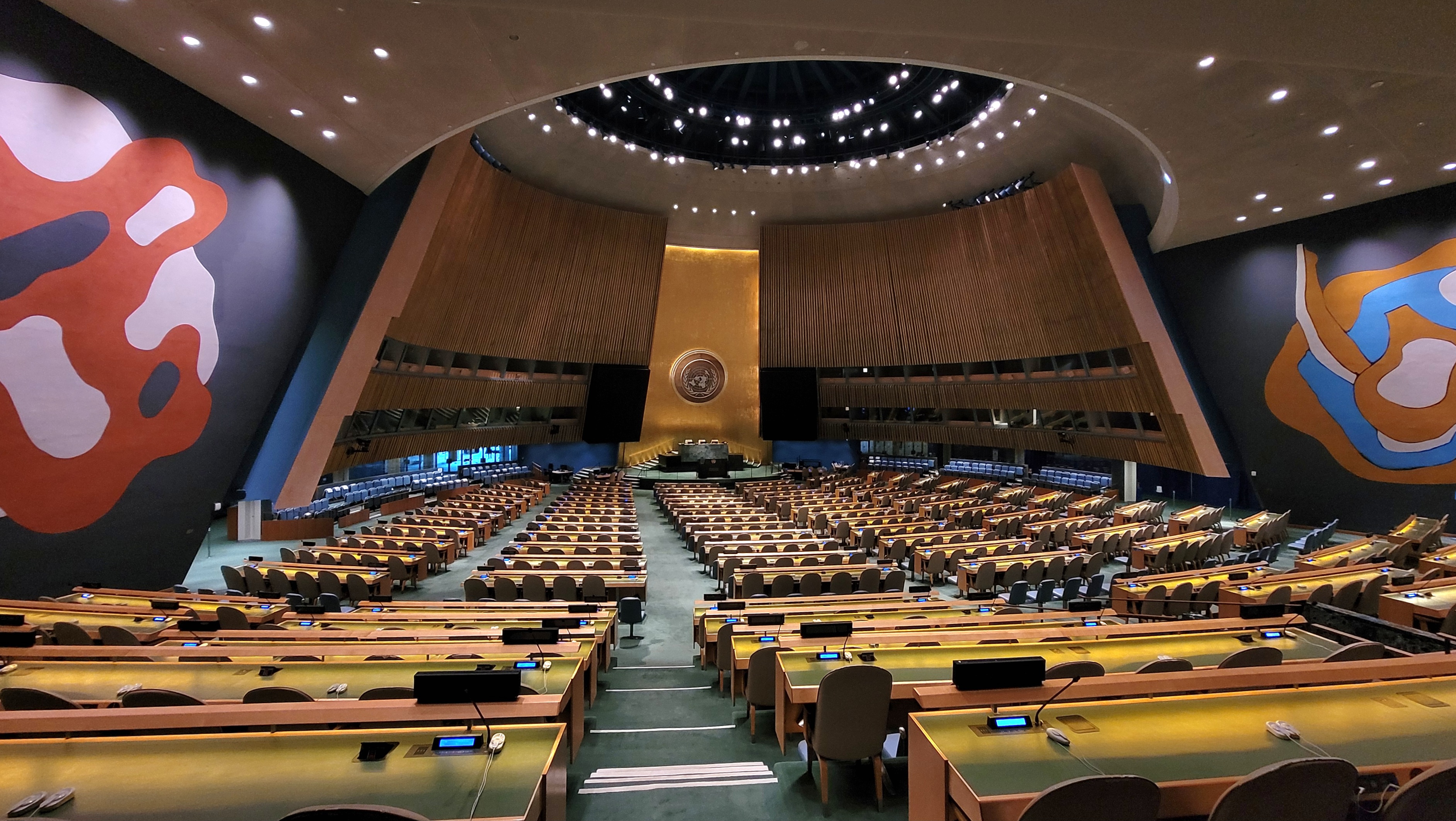
India used its right of reply at the UN General Assembly on Friday night to deliver a sharp rebuttal to Prime Minister Shehbaz Sharif’s address, accusing Pakistan of a long-standing policy of cross-border terrorism and warning that continued attacks would bring consequences. Islamabad answered the next morning with a right of reply of its own, rejecting the accusations and levelling counter-charges over Kashmir, India’s treatment of minorities and the Indus Waters Treaty.
First Secretary Petal Gahlot of India’s Permanent Mission to the UN told the Assembly that the “long-standing practice of cross-border terrorism by Pakistan” was at the heart of the dispute. “We demonstrated last year that terrorists will have nowhere to run and nowhere to hide,” she said, referring to Operation Sindoor, the military action India launched in May 2025 in response to the 22 April 2025 attack on tourists in Pahalgam that killed 26 civilians. “Our right to defend ourselves against terrorism will be exercised and continued. Terrorism by Pakistan will have consequences,” she added, according to DW, The Hindu and other outlets.
The ‘puppet regime’ charge
Gahlot went beyond the terrorism warning to attack Pakistan’s political system, describing it as “a regime of the army, by the army, and for the army”, according to the reports. “We heard some hypocritical homilies about democratic rights and human values from a regime whose capital at this very moment is being fortified against its own people,” she said — a reference to the extensive security measures and road closures in Islamabad around the scheduled Pakistan Tehreek-e-Insaf protest march.
She invoked the 27th Constitutional Amendment, which grants the Chief of Defence Forces and Chief of the Army Staff Field Marshal Asim Munir lifelong immunity from prosecution, saying “the reality of Pakistan is expressed in its 27th Amendment and the lifelong immunity granted to its real ruler”. The Indian diplomat also said the views heard from the Pakistani prime minister “emanate from those with a long record of bigotry and hatred”, describing the country as “the very regime whose mainstay is blasphemy laws”.
Kashmir and the Indus waters
On Kashmir, Gahlot reiterated that the Indian-administered territory “is an integral and inalienable part of my country and will always remain so”, and turned the discussion towards the part of Kashmir under Pakistani control. “If we must talk about Kashmir, let us turn our attention to the Pakistan-occupied Jammu and Kashmir. Ask the people of Rawalakot about the wanton killings, the brutal violence and the denial of basic rights that they have long experienced,” she said.
The exchange followed Shehbaz Sharif’s address, in which he called for a “just and fair resolution of the Kashmir dispute”, accused India of “weaponizing” water, and warned that any attempt to stop, impede or divert Pakistan’s share of the Indus waters would be treated as an act of war. KhabarWire has previously examined the argument that India’s abeyance of the treaty weaponised water. He also credited US President Donald Trump with a “timely intervention” that he said helped end the May 2025 military confrontation — an account India has consistently rejected, insisting no third party brokered a ceasefire. Gahlot referred to the presence of Al-Qaeda founder Osama bin Laden in Abbottabad, near the Pakistan Military Academy, reminding the Assembly that the remarks came a fortnight after the 25th anniversary of the 11 September 2001 attacks.
Pakistan’s counter-reply
Pakistan’s UN mission exercised its own right of reply through Counsellor Saima Saleem. She described India as a state “that has elevated propaganda into statecraft, embraced disinformation as diplomacy and exports terrorism as an instrument of policy”, and said New Delhi “exports terrorism and violence while trying to import victimhood and sympathy”, according to Geo News and Dawn.
Saleem cited the case of former Indian naval commander Kulbhushan Jadhav, convicted in Pakistan on espionage and terrorism charges, and of Nikhil Gupta, who pleaded guilty in the United States to plotting the murder of a Sikh leader at the direction of the Indian government, saying India’s “terrorist exports have gone from regional to global”. She said Pakistan had lost nearly 100,000 lives to terrorism since the turn of the century, and that Islamabad had presented evidence of Indian financing and abetting of groups including the banned Tehreek-e-Taliban Pakistan, the Balochistan Liberation Army and the Majeed Brigade.
She also criticised what she called the “institutionalised” Hindutva ideology of India’s ruling dispensation, saying Muslims were demonised, Christians persecuted, Dalits dehumanised and Sikhs disenfranchised, in what she called “the largest hypocrisy in the world”. On the Indus waters, she said India had “stooped to a new low of weaponising water, a lifeline for the 240 million people of Pakistan”.
What is still uncertain
Both statements are official diplomatic positions, not negotiated outcomes, and the two countries’ accounts of the May 2025 conflict remain irreconcilable: Pakistan says its forces repulsed an Indian attack and that a US-brokered ceasefire ended the fighting, while India says its strikes were retaliation for Pahalgam and that no third party intervened. Nothing in the exchange changes the underlying deadlocks over Kashmir, the Indus Waters Treaty — which India placed in abeyance in April 2025 and has said it will not revive until Pakistan takes what New Delhi calls credible action against cross-border terrorism — or the broader relationship.
The right-of-reply ritual is a standard feature of UN General Assembly high-level weeks, and the sharpness of the language does not by itself signal a new phase of escalation. The practical test remains whether either side’s rhetoric translates into action on the ground. As always, this is a dated snapshot: the UNGA session and the diplomacy around it are still unfolding.
Sources & reporting notes
This is a synthesis of published reporting and official statements, not eyewitness reporting. Sources were reviewed on 26 September 2026.
- DW — India, Pakistan trade accusations at UN General Assembly26 September 2026 · Independent account of the right-of-reply exchange, including Gahlot's "terrorism, deceit and duplicity" warning and the dispute over the May 2025 clash.
- Geo News — India's terrorist exports have gone from regional to global, Pakistan tells UNGA26 September 2026 · Pakistan's right of reply through Counsellor Saima Saleem, including the Jadhav and Gupta references and the Hindutva remarks.
- The Hindu — India criticises Pakistan's 'falsehoods' and 'deceit' at UN; warns terrorism will have consequences26 September 2026 · Independent report on India's right of reply, including the "puppet regime" characterisation and the bin Laden reference.
- Dawn — 'Largest hypocrisy in the world': Pakistan tells UNGA India's 'terrorist exports' have gone global26 September 2026 · Pakistani outlet's account of Saima Saleem's right of reply and its Indus waters passages.