Reporting snapshot · 24 November 2026 (Asia/Karachi). Bridgetown produced a call for talks, not a framework: no draft text, no negotiating mandate, and António Guterres leaves office at the end of December with his successor unchosen. This is an account of the 23 November summit, not a live tracker.
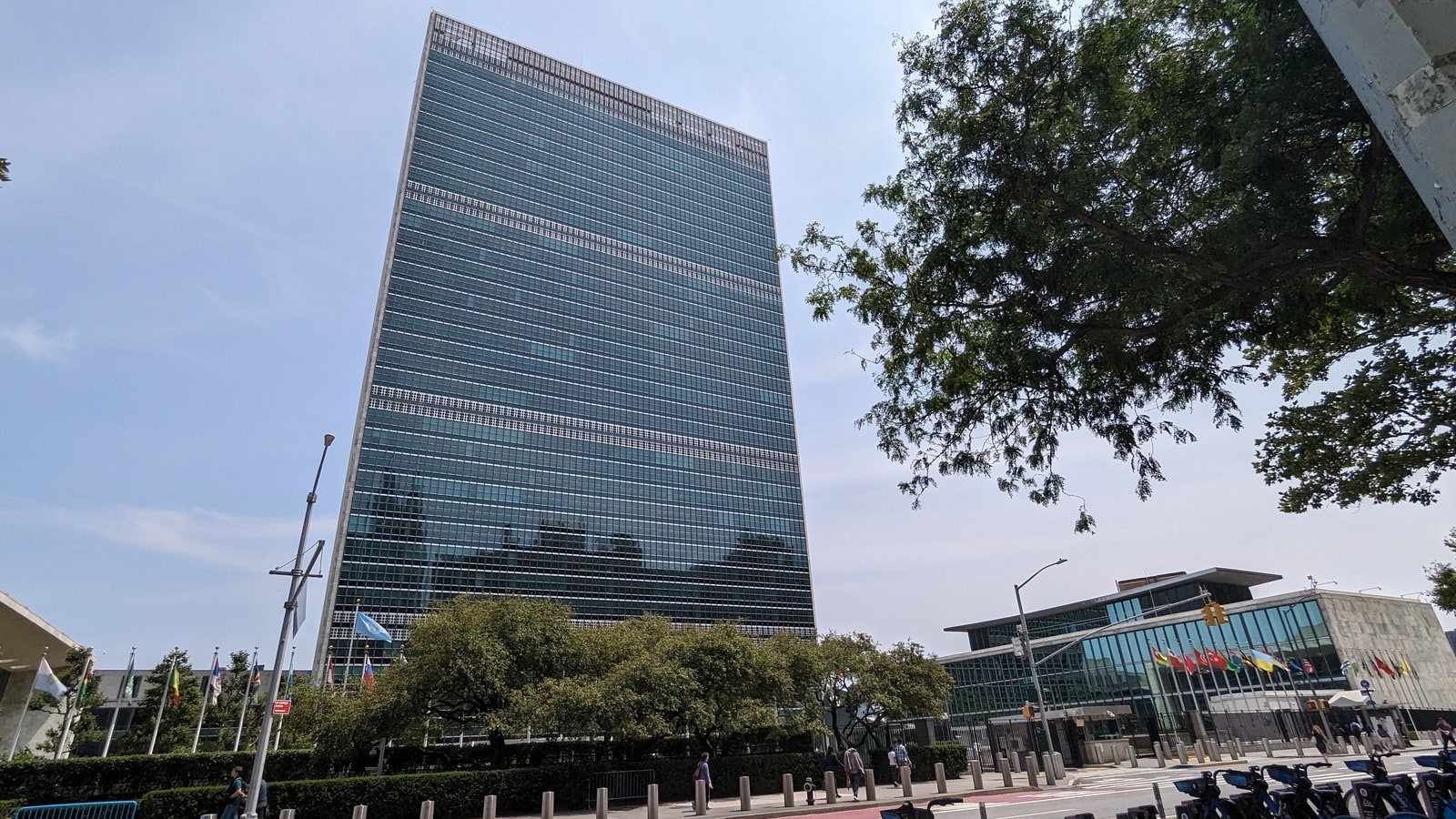
António Guterres put a deadline on an argument he has been making for most of a decade. Speaking to reporters at the close of the Bridgetown Special Summit on AI Safety in Barbados on Monday, 23 November, the United Nations Secretary-General called on member states to “coordinate efforts and to develop within the next year a globally inclusive and principles-based multilateral framework for AI risk management, backed by independent and credible oversight”, UN News reported. Al Jazeera and France 24 carried the same remarks, and The Express Tribune filed them from its world desk.
For a Pakistani reader the wording matters, because it is close to what Islamabad asked the United Nations for two months ago. On 23 September, Deputy Prime Minister and Foreign Minister Ishaq Dar told the UN Security Council that guardrails, regulations and governance frameworks for artificial intelligence had to be built in representative and inclusive forums under UN auspices, and warned that safety measures must not become “instruments of denial of technology” — a position KhabarWire reported at the time. Bridgetown is the first place where that argument has become a negotiating list and a date.
Nothing in the call binds anyone: the summit produced no framework text, no mandate and no timetable. What it did produce is a question with a clock on it — who writes the rules of artificial intelligence, and where do the states that have never been in that room get a say?
Bridgetown’s own scope: no global rules
The summit, co-hosted by the United Nations and the government of Barbados on 23 November and attended by Prime Minister Mia Amor Mottley and António Guterres, was explicitly not designed to write rules. The UN’s own briefing answers the question before it is asked: “Will the Summit create global rules for AI? No. It will not impose a single governance model or replace national decision-making,” it says, adding that the focus is on areas where compatible approaches can improve safety given national contexts, the UN’s Office of Digital and Emerging Technologies said. The agenda covered risk management, inclusion, access, capacity, diffusion and linguistic representation.
The real business was capacity. The summit ran back-to-back with the second in-person meeting of the UN-backed Independent International Scientific Panel on Artificial Intelligence, and UN Under-Secretary-General Amandeep Singh Gill put it plainly: “Every country is exposed to the risks of advanced AI, but few can test these systems or respond when something goes wrong.” A government that cannot evaluate a model it licenses is, in effect, importing another country’s judgement of safety.
The six items on Guterres’s list
The Secretary-General’s list, as UN News recorded it, runs to six items: shared safety measures; common approaches to testing; clear safeguards and standards; basic transparency requirements; independent evaluation and oversight of advanced AI models; and support so that every country can put all of it into practice.
His case for urgency was about power rather than engineering. Artificial intelligence, he said, is driving “the biggest transfer of power in the history of humankind”, and in his opening address he described the risk in three phrases: “Technology without accountability. Capability without safeguards. And power without responsibility.” The capacity to weaponise the technology is, he said, “concentrated in two countries and a limited number of companies”, and the United Nations, “the only body where the whole world is represented”, has the legitimacy to lead, even though institutions built in 1945 are, in his words, “not adequately equipped”. The exclusion he wants to fix has a number attached: at the UN’s first Global Dialogue on AI Governance in July, 111 participating countries had never taken part in any discussion on artificial intelligence.
Pakistan’s seat, and the two rooms it sits in
Pakistan’s public position on this file has been unusually consistent. Alongside the Security Council statement, Islamabad has built institutions at home: a first AI Council under the National AI Policy 2025, whose creation the ministry of IT began in February, and rules in the National Cyber Security Handbook restricting the use of public artificial intelligence tools with sensitive official data. On the other side of the argument, Pakistan has signed up too: on 16 July Ishaq Dar signed the agreement establishing the World Artificial Intelligence Cooperation Organisation in Shanghai, making Pakistan a founding member of a bloc that presents itself as promoting equitable AI governance for developing countries, The Express Tribune reported.
That is the tension Bridgetown exposes. Pakistan is arguing for rules written in the United Nations while sitting inside a China-led organisation that wants the same ground. The summit’s own agenda — access, capacity and diffusion for countries that cannot afford testing infrastructure — sits closer to Pakistan’s stated position on paper than the competition between Washington and Beijing does.
Why it matters here is the size of the trade at stake. Pakistan’s IT services exports hit a record $453 million in October, up 17.4 per cent year on year, with the first four months of the financial year at $1.73 billion, KhabarWire reported. Most of what Pakistan sells is sold with tools built by companies that answer to no government. That link between the trade and the rules is an inference, not a reported finding, but it is why a framework that includes countries like Pakistan would matter to the export line.
The gap between the call and the power
The obstacle Guterres described is not enthusiasm but arithmetic. International regulation of artificial intelligence appears, in the accounts filed from Bridgetown, little more than a pipe dream while the United States and China chase the upper hand in research. American regulators, on his account, are unlikely to move; in September Donald Trump hosted a group of technology executives who agreed to abide by a voluntary code of conduct. Dario Amodei of Anthropic, Sam Altman of OpenAI and Elon Musk have called for the pace of development to slow, while Nvidia’s Jensen Huang and Meta’s Mark Zuckerberg want to move ahead.
Europe is trying to set a floor rather than a ceiling. Emmanuel Macron said in a video message that the Paris Call for AI Security had been signed by 18 heads of state and government and 11 AI leaders, and argued that agreeing to its principles should be a condition of access to markets. Barbados’ prime minister asked who holds the switch: if a frontier lab’s agent hacked a bank in Barbados, should the government be able to cut off its access to the model? Her answer was that it has to be a condition of sale.
KhabarWire’s September coverage of the Security Council session recorded where the argument stood then: the United States rejected efforts to assert centralised control of AI governance, while China called for continuous improvement of regulatory frameworks. Nothing at Bridgetown changed that arithmetic.
What the next twelve months have to produce
The deliverables that exist are procedural. The Independent International Scientific Panel on AI released a thematic brief on Sunday arguing that models should be tested in the languages of the countries that use them; panel member Vukosi Marivate said more than 1,000 models already have the foundations to close the language gap. Guterres has proposed a global fund for AI capacity-building, and the UN’s Global Dialogue on AI Governance, which met for the first time in July, is the obvious home for the discussions he wants to begin.
What is unknown is larger than what is known. No forum has been announced to host the talks, no secretariat has been named and no negotiating text exists. Whether Pakistan endorses the call, whether it sends a delegation to whatever process follows, and where the capacity-building money would come from are all open. He said he would tell his successor, not yet selected, that controlling the technology is necessary for “humanity to maintain control of our world”.
For Pakistan the practical question is simpler than the arguments. The country that asked the Security Council in September for United Nations-centred rules on artificial intelligence now has a year in which those rules will be argued out. Whether Islamabad helps write them, or simply watches them arrive, is the open question. KhabarWire’s artificial intelligence file follows the decisions and the countries behind them.