Reporting snapshot · 3 September 2026. The decagon has been measured in observations beginning in 2023, but its cause and long-term stability remain unresolved. Explanations of its formation are hypotheses being tested, not settled conclusions.
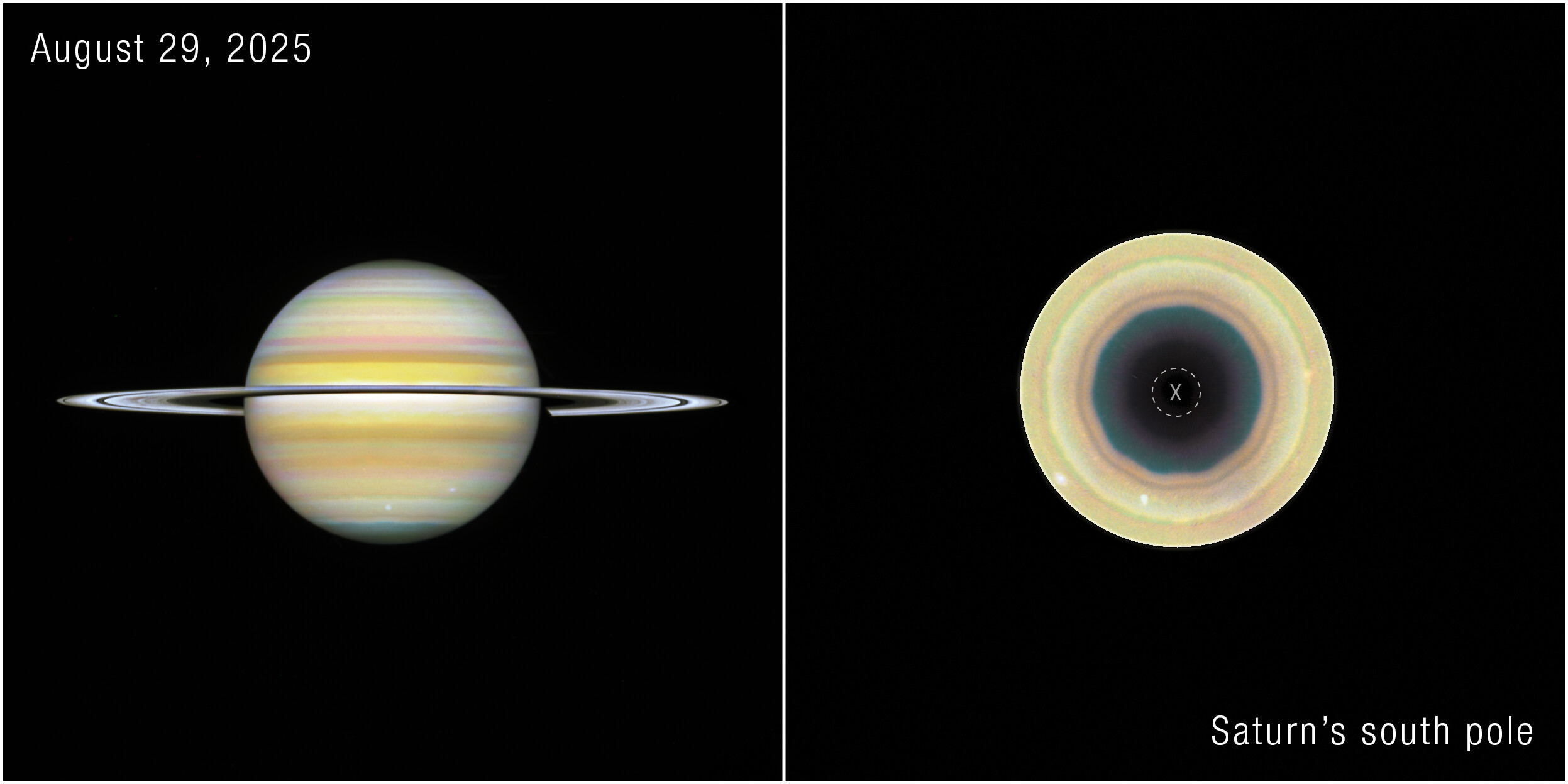
What Hubble found at Saturn’s south pole
Scientists have identified a vast, 10-sided atmospheric wave circling Saturn’s south pole, the first large regular-sided jet pattern measured in the planet’s southern hemisphere. The feature—described in a peer-reviewed study published in Science Advances on 2 September—is not a solid shape or the boundary of a single storm. It is a meandering wave embedded in one of Saturn’s fast east-west jet streams, with clouds making the geometry visible.
The decagon is enormous. Its full span is about 167,800 kilometres, according to the measurements reported by Space.com, and each side is roughly 16,800 kilometres long—greater than Earth’s diameter. Observations at several wavelengths indicate that the pattern extends through multiple atmospheric levels rather than existing only in a thin cloud layer.
Researchers did not spot the structure in one isolated picture. Amateur astronomers Trevor Barry and Jean-Paul Oger first helped draw attention to an undulating southern band in ground-based images. The team then examined annual observations from Hubble’s Outer Planet Atmospheres Legacy programme. ESA/Hubble’s account of the discovery says faint signs were present in Hubble data from 2023 and grew more distinct in 2024 and 2025.
That sequence matters because earlier searches had found no persistent southern counterpart to Saturn’s famous north-polar hexagon. Cassini, which orbited Saturn from 2004 to 2017, did not record the new decagon as a long-lived feature. Saturn’s tilt also kept the southern polar region poorly placed for Earth-based viewing from 2012 until 2023. The available evidence therefore points to a pattern that emerged, or at least became observable, during a long gap in clear views.
Why Saturn’s decagon is not simply a second hexagon
Saturn’s northern hexagon has persisted through more than 40 years of spacecraft and telescope observations. It is almost stationary relative to Saturn’s rotation and is carried by a powerful jet near 78 degrees north latitude. The new decagon sits near 63 degrees south and behaves differently.
The southern pattern drifts eastward at about 2.5 metres per second, or roughly 10 kilometres per hour. Its vertices also oscillate over about 32 days, and some sides appear less sharply defined than others. Those measurements suggest an evolving or possibly temporary wave rather than a stable southern copy of the hexagon. As the Associated Press reported, the decagon would take roughly 800 days to complete a circuit around the planet at that drift rate.
The comparison still changes an important premise. For decades, the north-polar hexagon could be treated as an exceptional structure with no equivalent elsewhere on Saturn. A southern polygon with different dimensions and motion suggests that regular-sided waves may arise under a wider range of Saturnian conditions. Scientists can now test explanations against two natural cases instead of asking one model to reproduce a single unusual feature.
How a jet stream can trace a polygon
The word “decagon” describes the wave’s outline, not a rigid object. Saturn is a rapidly rotating gas giant whose atmosphere is organized into bands of winds flowing east and west at different speeds. A narrow jet can become unstable and meander. Under the right conditions, the wave can settle into a repeating sequence of bends that looks like straight sides joined at corners.
Researchers have produced polygonal flows in laboratory tanks of rotating fluid, and numerical models show that the number of sides can vary. It depends on factors including the jet’s speed and depth, its latitude, the planet’s size and rotation, and interactions with nearby vortices. In an independent assessment collected by Science Media Centre Spain, planetary-atmosphere researcher Miguel Ángel López Valverde said the new observation fits the broad expectation that polygonal waves can form at the edges of strong, narrowing zonal winds.
That general mechanism is plausible; the specific trigger is not known. A nearby high-pressure vortex may have disturbed the southern jet and forced it into the 10-sided pattern. Alternatively, an instability within the jet or a disturbance rising from deeper in Saturn’s atmosphere could be responsible. The study’s simulations are an initial attempt to distinguish among those possibilities, not proof of one origin.
Why the discovery matters beyond its shape
Planetary scientists cannot place instruments throughout Saturn’s deep atmosphere or repeat controlled experiments there. A new feature that changes over time functions as a natural experiment. Its drift, vertical reach and interaction with surrounding winds constrain models of how energy and momentum move through a giant planet.
The decagon also connects professional observatories with a long-running network of skilled amateurs. Ground-based observers flagged a subtle pattern; Hubble supplied sharper, multi-wavelength measurements over full rotations; and the European Southern Observatory’s Very Large Telescope helped measure winds. The discovery depended on comparing those observations across years, illustrating why systematic monitoring can reveal changes that a one-off mission or image would miss.
Better models of Saturn’s polygons may also sharpen comparisons with Jupiter. Jupiter’s poles contain groups of cyclones arranged geometrically, but astronomers have not observed the same kind of polygonal jet wave there. Explaining why similar rapidly rotating gas giants organize their polar weather differently is part of the broader problem this discovery can help address.
What remains uncertain—and what scientists will watch next
The central unknown is whether the decagon will persist. Saturn is moving toward southern summer, increasing sunlight at the relevant latitudes until around 2032. If seasonal heating contributes to the pattern, it may strengthen. It could instead distort or disappear, revealing that the southern atmosphere supports only transient polygons.
Scientists also need to determine whether the nearby vortex created the wave, was shaped by it, or is merely coincidental. More observations at different wavelengths can trace the pattern at different heights, while repeated wind measurements can show whether its drift and 32-day oscillation remain consistent.
The discovery does not yet provide a complete theory for Saturn’s polar geometry. Its value lies in making that theory more testable. A model that claims to explain the enduring northern hexagon must now also account for a larger, slower-moving and apparently younger 10-sided wave in the south—and predict how that wave changes as Saturn’s season advances.