Reporting snapshot · 29 November 2026 (Asia/Karachi). Rs3.04 per unit is the rate the Power Division has asked NEPRA to determine; the regulator has not decided it and no bill has changed. The monthly fuel charge for December and the distribution companies' quarterly adjustment are both still open, and a bill carries more than the fuel line.
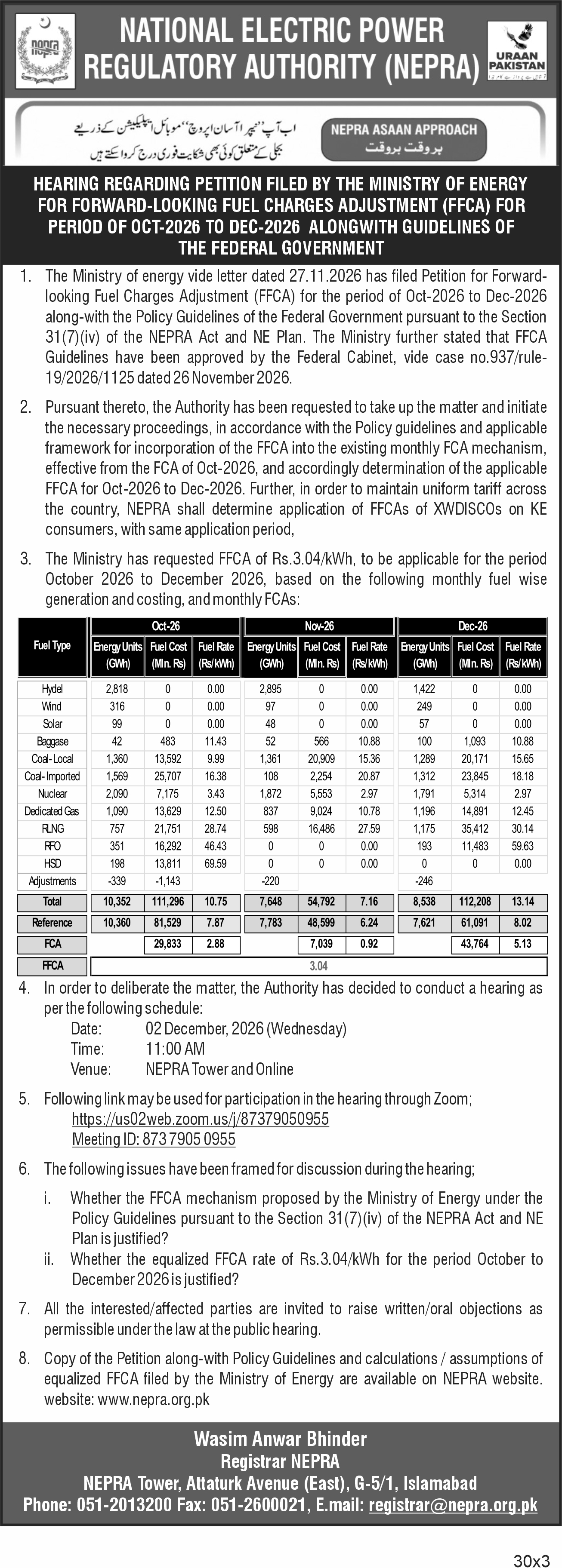
Pakistan’s power ministry has asked the National Electric Power Regulatory Authority (NEPRA) to charge electricity consumers a flat Rs3.04 per unit of electricity for the fuel the grid burns, and the regulator has called a public hearing on the request for 2 December at 11am at its tower in Islamabad and online. The Ministry of Energy, which runs the Power Division, filed the petition on 27 November, and NEPRA published the notice of hearing together with the ministry’s petition and the federal government’s policy guidelines on 28 November. The charge covers electricity used in October, November and December 2026 and would appear on bills issued from December through February 2027.
The request is the mechanism the Power Division first described on 26 November, when it told NEPRA it would limit the fuel increase for the same three months to about 83 paise a unit; KhabarWire reported that proposal, and the gap with the Rs2.88 the power companies had sought, separately. What has changed since then is that the guidelines are approved, the petition is formally before the regulator, and the figure has a name and a hearing date. The federal cabinet approved the guidelines for a Forward-Looking Fuel Charges Adjustment (FFCA) on 26 November under case number 937/rule-19/2026/1125, and the ministry’s letter asked NEPRA to begin proceedings folding the new charge into the existing monthly fuel charges adjustment (FCA) mechanism from the October FCA onwards, Business Recorder reported.
For a household, the change is arithmetic. Instead of three different fuel charges across three bills, the same Rs3.04 per unit would appear on the December, January and February bills. Dawn reported that the requested rate is 67 paisa above the September adjustment now on bills, and that the Power Division’s 83 paise figure was the same increase once taxes were added. The file is tracked in KhabarWire’s Pakistan Fuel & Energy hub.
How the Rs3.04 was worked out
The ministry’s petition and the fuel-cost tables behind it make the arithmetic visible. In October the system generated 10,352 GWh at a fuel cost of Rs111.296 billion, an average of Rs10.75 a unit against a reference cost of Rs7.87, which produces a monthly adjustment of Rs2.88. November is projected at 7,648 GWh and Rs54.792 billion, an average of Rs7.16 against a reference of Rs6.24, giving 92 paisa. December is projected at 8,538 GWh and Rs112.208 billion, an average of Rs13.14 against a reference of Rs8.02, giving Rs5.13.
Rs3.04 is not the average of those three rates. Adding the three adjustments gives Rs80.6 billion, and dividing that by the 26,538 GWh sold across the three months gives Rs3.04 a unit. Because November has the fewest units, its low rate carries less weight than it would in a simple average, and the result sits a few paisa above Rs2.98.
What separates December is the fuel mix. The tables show imported coal generation rising from 108 GWh in November to 1,312 GWh in December at Rs18.18 a unit, and regasified liquefied natural gas rising from 598 GWh to 1,175 GWh at Rs30.14 a unit, while high-speed diesel drops out of the mix altogether. The ministry’s simulation assumes Brent crude at $93 a barrel against the $70 benchmark used to set base tariffs, imported coal at $125 a tonne against $85, contracted RLNG at $16 an MMBtu against $11, no additional local gas allocation in November or December, and more than 80 per cent dependence on thermal generation, with one and a half to two hours of load management. The federal guidelines describe harsher conditions still, citing Brent above $120 a barrel and imported coal at $123 a tonne against benchmarks of $70 and $85, and blaming the closure of the Strait of Hormuz and the force majeure declared by Qatar.
What changes on the bill from December
The charge will be billed separately from the base tariff, on the units a consumer actually uses in the month, and it starts with the December billing month. The relevant baseline is the September adjustment of Rs2.3673 per unit that NEPRA approved on 6 November and which is on bills now, as KhabarWire reported when it was decided. Rs3.04 is 67 paisa above it.
On the fuel line alone, a household using 300 units a month would pay Rs912 on each of the December, January and February bills instead of the Rs710 it pays today, roughly Rs202 a month more for three months, before sales tax, electricity duty, slab rates and fixed charges. A household on 100 units would pay Rs304 rather than Rs237. Left alone, the ministry’s own figures would have been far less even: Rs864 on the December bill for October use, Rs276 on the January bill for November use and Rs1,539 on the February bill for December use, at 300 units a month. Equalising removes the February spike and adds to January.
What the new mechanism changes
The point of the FFCA is to stop the monthly line moving while the underlying cost swings. The existing FCA settles each month on what the system actually burned against a reference rate and recovers it two months later, a lag the Power Division says leaves distribution companies financing the difference and leaves consumers with an unpredictable charge. Under the guidelines the monthly FCA keeps running alongside the new adjustment, with any over- or under-recovery carried into the next control period as a prior-period adjustment for fuel variation.
The first control period is three months, October to December 2026, and the guidelines allow subsequent periods of six months, with NEPRA determining each rate on past trends and the outlook for the period ahead. The same rate is to apply to K-Electric consumers over the same period, and any difference between the monthly adjustment determined for K-Electric and the notified FFCA is to be met by subsidy or cross-subsidy, keeping the fuel line uniform across the country. The mechanism rests on section 31(7)(iv) of the NEPRA Act and the National Electricity Policy.
What the 2 December hearing has to settle
NEPRA has framed two questions: whether the FFCA mechanism proposed by the ministry under the guidelines is justified, and whether the equalised rate of Rs3.04 a unit for October to December is justified. The notice allows written or oral objections from any interested party, to be sent to NEPRA’s registrar or raised at the hearing.
Three things remain open. Rs3.04 is a request, not a decision, and nothing on a bill changes until NEPRA notifies one. The distribution companies’ quarterly adjustment claim of Rs1.34 a unit, heard on 17 November, is still reserved and would reach bills separately, as KhabarWire reported at the time. And NEPRA’s September decision excluded lifeline consumers, electric vehicle charging stations and consumers on prepaid tariffs from the adjustment; the notice does not say whether the same exclusions carry into the FFCA.
Two assumptions behind the request sit awkwardly. The projection needs one and a half to two hours of load management through the winter, and it asks NEPRA to judge the mechanism on a cost base built around $93 a barrel of Brent while the same document records Brent above $120. Whether a rate fixed in November survives a January in which fuel arrives at the numbers the ministry’s own tables anticipate is the sharpest question the hearing on 2 December has to answer.