Reporting snapshot · 18 November 2026 (Asia/Karachi). Neither adjustment has been approved. NEPRA reserved its decision on the quarterly tariff claim after the hearing on 17 November, and the October fuel charge is still to be argued on 26 November, so Rs4.22 per unit is the sum of two pending claims rather than a settled change in bills. The companies' loss calculations used a September fuel adjustment that had not been notified when they filed.
Two tariff adjustments now before the National Electric Power Regulatory Authority (NEPRA) would together add up to Rs4.22 per unit to Pakistan’s December electricity bills if both are approved in full. On Tuesday, 17 November, the regulator concluded the hearing on the power distribution companies’ quarterly adjustment claim for the July-September quarter and reserved its decision, as The Express Tribune reported. On Wednesday it posted the notice of hearing for a second and larger claim: the Central Power Purchasing Agency-Guarantee’s request for an October fuel charges adjustment of Rs2.8819 per unit, to be argued on 26 November.
The Rs1.34 comes from the quarterly adjustment, which the companies want to recover over three months from December to February; the Rs2.88 comes from the monthly fuel charge. Both would reach K-Electric customers as well as the ex-Wapda distribution companies, because federal government policy requires the same fuel and quarterly adjustments across both.
The quarterly claim is not a fuel price
The quarterly adjustment is a true-up of the fixed and semi-fixed costs the distribution companies pass on to consumers, and it works differently from the fuel charge. Its three main heads are the capacity payments the companies make to generators for keeping plant available, the effect of transmission and distribution losses on the monthly fuel cost adjustment, and variable operation and maintenance costs.
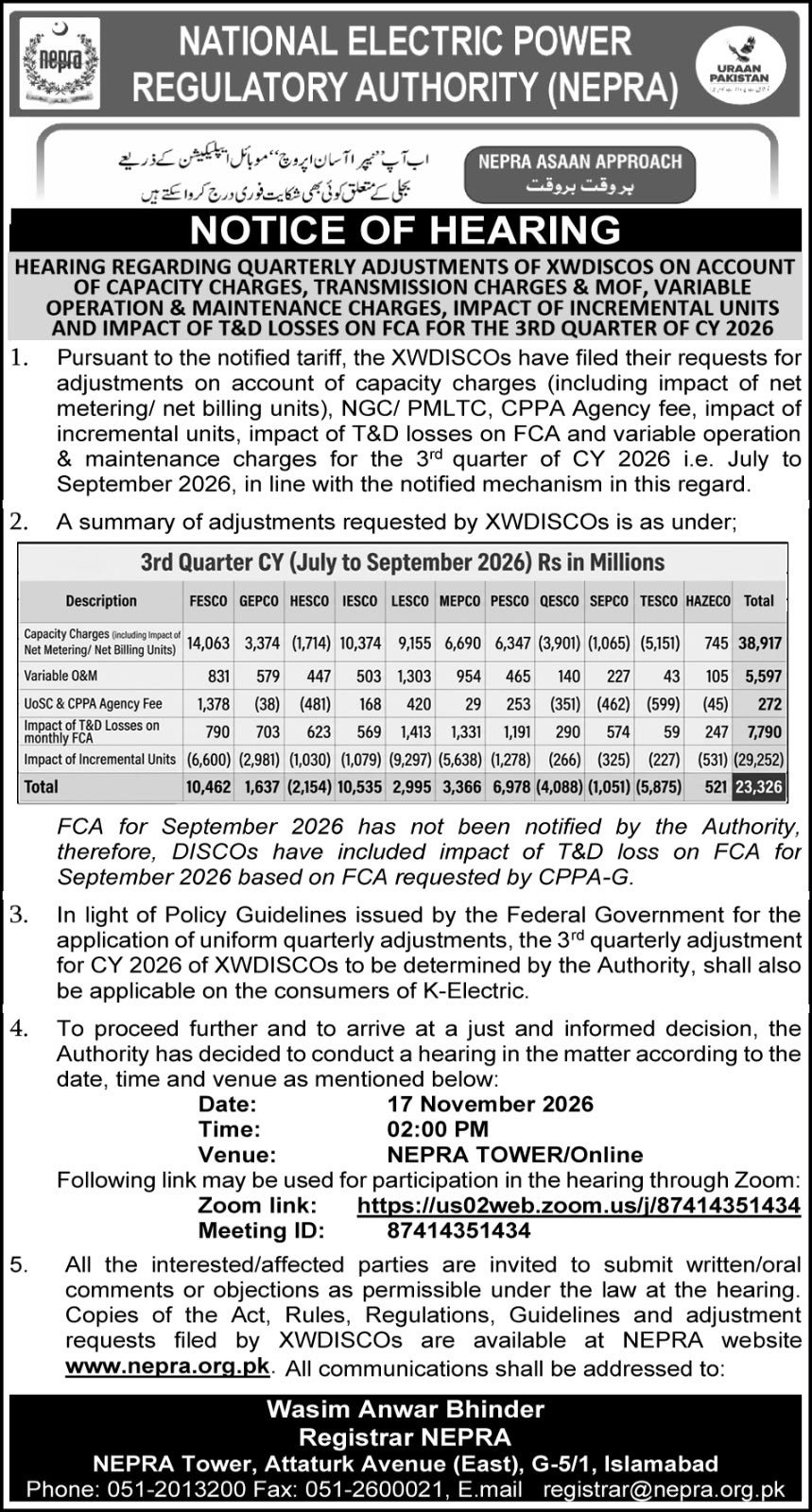
According to the applications filed with NEPRA and set out by Profit by Pakistan Today, the companies sought Rs38.917 billion in capacity charges, including the effect of net metering and net billing, Rs7.790 billion for the impact of transmission and distribution losses on fuel cost adjustments, Rs5.597 billion in variable operation and maintenance costs, and Rs272 million under use-of-system charges and the CPPA-G market operator fee. Against that, a negative adjustment of Rs29.252 billion arising from incremental electricity consumption cancels much of the claim, leaving Rs23.326 billion to be recovered from consumers. The applications and the combined third-quarter data are on NEPRA’s notice of hearing.
NEPRA chairman Waseem Mukhtar presided over the hearing. The regulator noted that the September 2026 fuel charge had not been notified when the companies submitted their applications, so they had calculated the loss impact using the fuel adjustment CPPA-G had requested rather than one the authority had approved, The Express Tribune reported. That is a technical point with a practical edge: part of what the companies are asking to recover rests on a September outcome the regulator had not yet settled, so the loss figures could move again before NEPRA decides.
Rs2.88 on top of a Rs10.75 fuel cost
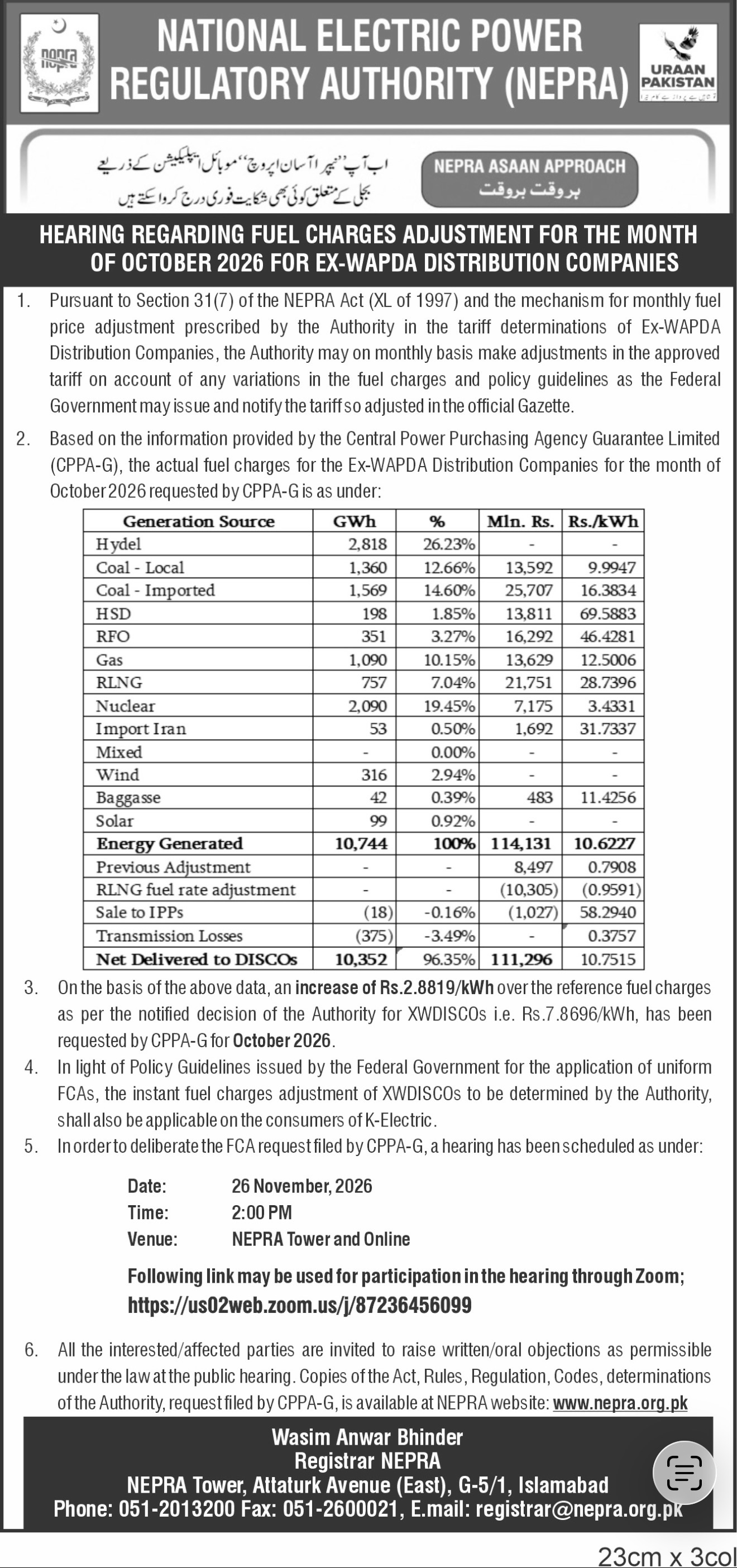
The second claim is the familiar monthly one. CPPA-G has asked NEPRA to approve an October fuel charges adjustment of Rs2.8819 per unit against a reference fuel cost of Rs7.8696 per kilowatt-hour, The News International reported, noting that the actual fuel cost of the power supplied to the distribution companies in October was Rs10.7515 per unit. The overall fuel cost of generation worked out at Rs10.6227 per unit, and after previous adjustments, RLNG fuel rates and transmission losses, the net fuel cost passed to the distribution companies was Rs10.7515.
NEPRA has scheduled the hearing for 26 November at its tower in Islamabad, with an online platform, and has invited written and oral objections. The notice of admission and hearing and the underlying CPPA-G October energy purchase data are on the regulator’s own site.
What the October generation mix explains
The fuel charge is the arithmetic of what Pakistan actually burned in October, and the mix explains why the number is what it is. CPPA-G’s data showed the power plants generating 10,744 gigawatt-hours, of which 10,352 GWh reached the distribution companies after transmission losses and sales to independent producers.
Hydropower was the largest source at 2,818 GWh, or 26.23 per cent, followed by nuclear at 2,090 GWh (19.45 per cent), imported-coal plants at 1,569 GWh (14.60 per cent), local-coal plants at 1,360 GWh (12.66 per cent), gas-fired plants at 1,090 GWh (10.15 per cent) and regasified liquefied natural gas at 757 GWh (7.04 per cent). The remainder came from residual fuel oil, wind, high-speed diesel, solar, 53 GWh imported from Iran and bagasse.
The cost of each fuel is where the pressure sits. High-speed diesel carried a fuel cost of Rs69.5883 per unit, residual fuel oil Rs46.4281 and electricity imported from Iran Rs31.7337. Regasified LNG at Rs28.7396 per unit and imported coal at Rs16.3834 sit well below those, and hydropower and nuclear below them again. The fuel charge is not a levy on the cheapest generation; it is the mechanism through which the cost of the whole mix, including the expensive fuels, reaches bills.
Who bears it, and where
The burden is not spread evenly across the distribution companies’ territories, and the filings show where it lands. IESCO sought the largest positive adjustment at Rs10.535 billion, followed by FESCO at Rs10.462 billion and PESCO at Rs6.978 billion, with MEPCO at Rs3.366 billion, LESCO at Rs2.995 billion, GEPCO at Rs1.637 billion and HAZECO at Rs521 million, Profit reported.
Several companies calculated negative adjustments. TESCO put its figure at negative Rs5.875 billion, followed by QESCO at negative Rs4.088 billion, HESCO at negative Rs2.154 billion and SEPCO at negative Rs1.051 billion. NEPRA will examine all of them before deciding what, if anything, is recoverable.
What NEPRA still has to settle
Two dates matter. The quarterly decision is reserved and can come at any point; the October fuel charge will be argued on 26 November and decided after that. Neither has been notified, so December bills are not yet set.
Three things are also open. The companies’ loss calculations used the fuel adjustment CPPA-G had requested for September, because the regulator had not notified its own September decision when the applications were filed, so a different September outcome would move the quarterly numbers. The uniform tariff policy means an adjustment approved for the ex-Wapda distribution companies reaches K-Electric consumers too, and NEPRA will decide the K-Electric application on the same basis, having set the incremental consumption package for industrial and agricultural users at Rs25.30 per unit in November. And the authority has not said how much of either claim, if approved, would be offset for bulk consumers.
This is the winter the Power Division warned about in October, when officials said fuel price adjustments could rise two to threefold between December and February, as KhabarWire reported at the time. The projected power purchase price CPPA-G filed for 2027 will set the year after that; these two claims are its first instalment. The tariff file is tracked in KhabarWire’s Pakistan Fuel & Energy hub.