Reporting snapshot · 20 October 2026 (Asia/Karachi). The figures below are CPPA-G projections filed for regulatory review, not a final tariff determination. NEPRA will hear objections on 3 November; the final consumer tariff will also depend on taxes, subsidies and other charges.
What CPPA-G has projected
Pakistan’s average power purchase price could reach Rs27.309 per kilowatt-hour (kWh) in calendar year 2027 under the base case filed by the Central Power Purchasing Agency-Guarantee Limited (CPPA-G), with total procurement costs estimated at Rs3.55 trillion. The projections are part of the rebasing of consumer-end electricity tariffs for the ex-WAPDA distribution companies (XWDISCOs), which is scheduled to take effect on 1 January 2027.
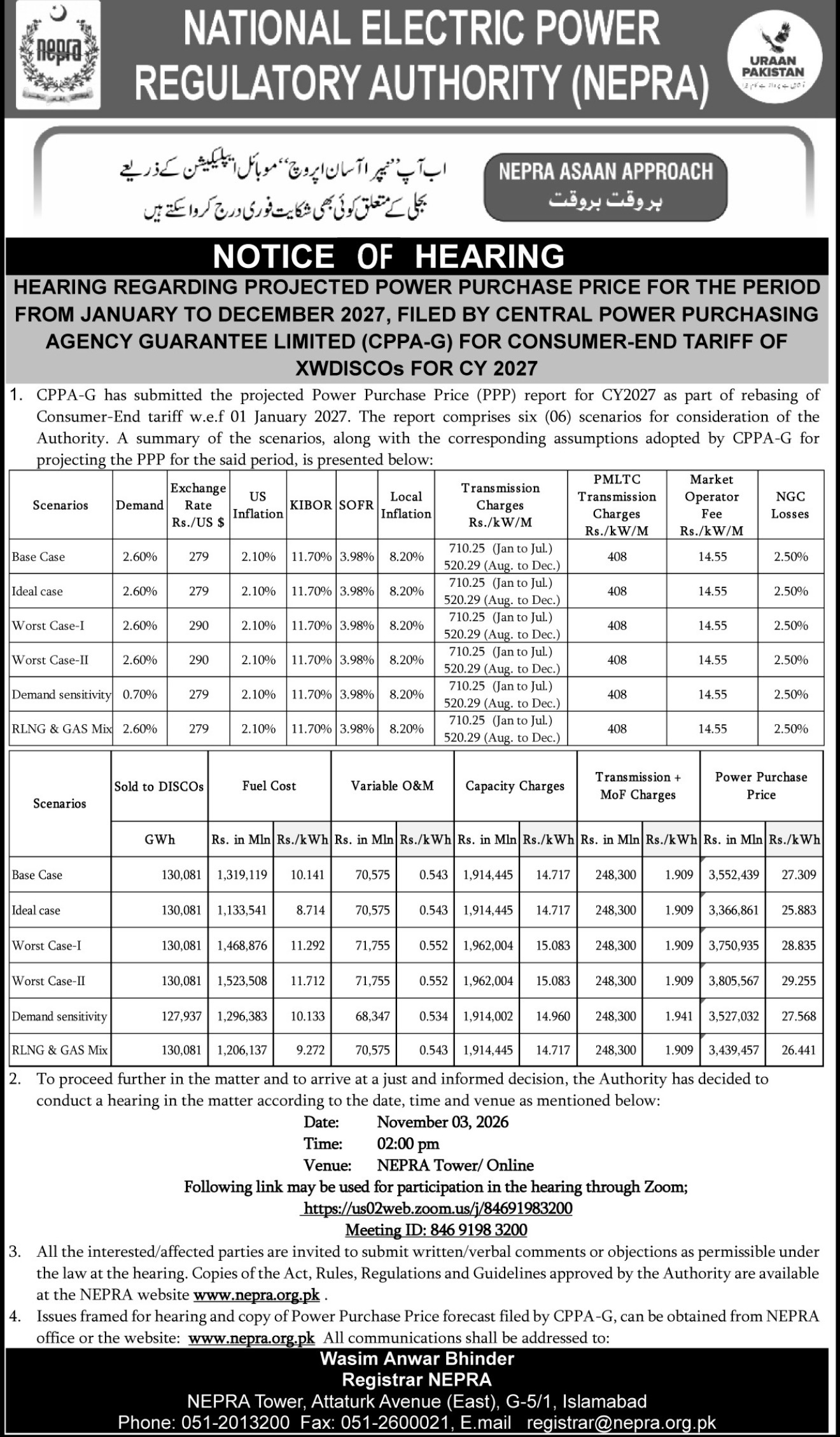
The News reported the filing on 20 October. Profit by Pakistan Today and Geo News carried the same core figures. NEPRA’s notice of hearing, posted on the regulator’s website, confirms that CPPA-G submitted a six-scenario report and that the public hearing will be held on 3 November 2026 at 2pm at NEPRA Tower in Islamabad, with online participation available through Zoom. Interested and affected parties have been invited to submit written or oral comments and objections.
The projected range is wide. The ideal scenario puts the purchase price at Rs25.883 per unit, while the second-worst case reaches Rs29.255 per unit — a difference of Rs3.372 per unit, or about 13 per cent above the ideal case.
Why capacity charges dominate the number
The largest block in the base case is not fuel. Capacity charges account for Rs1.914 trillion, or Rs14.717 per unit — just over half of the projected purchase price. Fuel costs account for Rs1.319 trillion, or Rs10.141 per unit, about 37 per cent of the total. Variable operations and maintenance add Rs70.575 billion, or Rs0.543 per unit, while transmission-related costs and Ministry of Finance charges add Rs248.3 billion, or Rs1.909 per unit.
Capacity charges are payments made for generation capacity that is available to the grid, rather than only for electricity actually produced. They cover fixed costs and returns on power plants, and they remain a central reason Pakistan’s electricity costs stay high even when demand is weak or fuel prices fall. The base case assumes electricity sales of 130,081 gigawatt-hours (GWh) to distribution companies and annual demand growth of 2.60 per cent, with an exchange rate of Rs279 to the US dollar.
That mix matters. A fall in fuel prices can lower the fuel component without doing much to capacity payments, which are fixed by contracts and tariff determinations. A weaker rupee, by contrast, can raise both fuel and capacity costs where payments are indexed to the dollar.
What the six scenarios show
The six scenarios test different assumptions, and the differences are large enough to change the policy debate.
| Scenario | Power purchase price | Main assumption |
|---|---|---|
| Ideal case | Rs25.883/unit | Lower fuel costs, with fuel at Rs8.714/unit |
| RLNG and gas mix | Rs26.441/unit | A different re-gasified LNG and gas supply mix |
| Base case | Rs27.309/unit | 2.60% demand growth; Rs279/US dollar; 130,081 GWh sold |
| Demand sensitivity | Rs27.568/unit | 0.70% demand growth; 127,937 GWh sold |
| Worst Case-I | Rs28.835/unit | Rupee at Rs290/US dollar; fuel at Rs11.292/unit |
| Worst Case-II | Rs29.255/unit | Rupee at Rs290/US dollar; fuel at Rs11.712/unit |
The demand-sensitivity case shows why weaker sales do not produce a lower price: with sales at 127,937 GWh, the same capacity and transmission costs are spread over fewer units, lifting the average to Rs27.568. In the two worst cases the rupee falls to Rs290 per dollar, fuel costs rise and capacity charges climb to Rs15.083 per unit. A weaker currency plus fixed capacity obligations explains why the top of the range is almost Rs3.4 per unit above the ideal case.
All six scenarios assume a Karachi Interbank Offered Rate of 11.70 per cent, a Secured Overnight Financing Rate of 3.98 per cent, US inflation of 2.10 per cent, domestic inflation of 8.20 per cent and National Grid Company losses of 2.50 per cent. Any change to those assumptions would move the projected price.
What this means for bills — and what it does not
The Rs27.309 figure is an average power purchase price, not a household tariff. It is one input into the consumer-end tariff, which also reflects taxes, duties, subsidies and other components, and NEPRA is not bound to accept CPPA-G’s assumptions or its proposed cost. The regulator’s final determination will set the reference costs that distribution companies can recover; the retail tariff that appears on a bill is a separate decision.
The rebasing is also different from the monthly fuel charges adjustment (FCA) that has dominated recent electricity news. An FCA reconciles the fuel cost allowed in the tariff with the fuel cost actually incurred in a given month. NEPRA added Rs1.11 per unit to October bills under the August FCA, as KhabarWire reported on 9 October. Distribution companies have since sought Rs2.5624 per unit for September, with a hearing set for 29 October, as KhabarWire reported on 17 October. The 2027 rebasing resets the annual reference costs rather than reconciling one month’s fuel bill.
The timing is politically sensitive. The projection lands as the government prepares to sell nine ex-WAPDA distribution companies by December 2027 under its IMF programme, a plan KhabarWire reported on 5 October. The fourth IMF review concluded on 8 October, as KhabarWire reported, with cost-reflective tariffs and energy reforms central to the programme. A higher purchase price would make it harder to hold retail tariffs down without a subsidy, adding to pressure on a sector already carrying large circular debt.
What is still uncertain
The base case is a filing, not a decision. NEPRA may revise the demand, exchange-rate, fuel, capacity or financing assumptions after the hearing, and the final reference costs could be higher or lower than Rs27.309 per unit. The government’s subsidy and tax decisions for 2027 are also unsettled.
Three uncertainties matter most. First, the rupee: the scenarios that assume Rs290 rather than Rs279 to the dollar are Rs1.5 or more per unit above the base case. Second, fuel prices and the availability of imported gas, which remain exposed to regional conflict and shipping disruption. Third, demand: if sales grow more slowly than assumed, the fixed capacity and transmission costs will be spread over fewer units, pushing the average price up rather than down.
The 3 November hearing is the next formal opportunity to challenge the assumptions. Until NEPRA issues its determination, the only defensible conclusion is that the filed base case points to a purchase price of about Rs27.31 per unit — not that household tariffs will rise by that amount, and not that the final number is settled.
Sources & reporting notes
This is a synthesis of published material, not eyewitness reporting. Sources were reviewed on 20 October 2026 (Asia/Karachi). The primary record is NEPRA's notice of hearing and CPPA-G's filed projections. The News published the detailed print report; Profit by Pakistan Today and Geo News carried separate accounts. The FCA and IMF references are from KhabarWire's earlier reporting, linked in the body.
- NEPRA — Notice of hearing: projected power purchase price for CY2027Notice dated 17 October 2026 · Confirms CPPA-G's six-scenario report for the XWDISCO tariff rebasing, the 3 November 2026 hearing at 2pm at NEPRA Tower and online, and the invitation for comments and objections; the attached table gives the base-case Rs27.309/unit and Rs3.552 trillion figures and the scenario assumptions.
- The News — Power purchase price projected at Rs27.31 per unit for 2027Published 20 October 2026 · The base-case Rs27.309/unit and Rs3.55 trillion procurement cost, the Rs25.883–Rs29.255 range, the capacity, fuel, O&M and transmission breakdown, the six scenarios and the 3 November hearing.
- Profit by Pakistan Today — Pakistan's power purchase price projected at Rs27.309/unit in 2027Published 20 October 2026 · Independent confirmation of the base case, the scenario range, the component costs and the 3 November NEPRA hearing.
- Geo News — Power purchase price may rise to Rs27.3 per unit in 2027: CPPA-GPublished 20 October 2026 · Confirmation of the filed projection, the capacity-charge share and the NEPRA hearing date.