Reporting snapshot · 2 September 2026. Contract milestones, launch dates, and technical architectures are subject to commercial development schedules, launch pad availability, and future federal budget authorizations.
What happened
NASA announced on 1 September 2026 that it has awarded private aerospace company Blue Origin a firm-fixed-price contract with a maximum potential value of approximately $700 million to build, launch, and operate the Mars Telecommunications Network. Under the terms of the agreement, Blue Origin must deliver a dedicated, high-performance telecommunications spacecraft to NASA no later than 31 December 2028, with full orbital operations around Mars scheduled to begin by 2030.
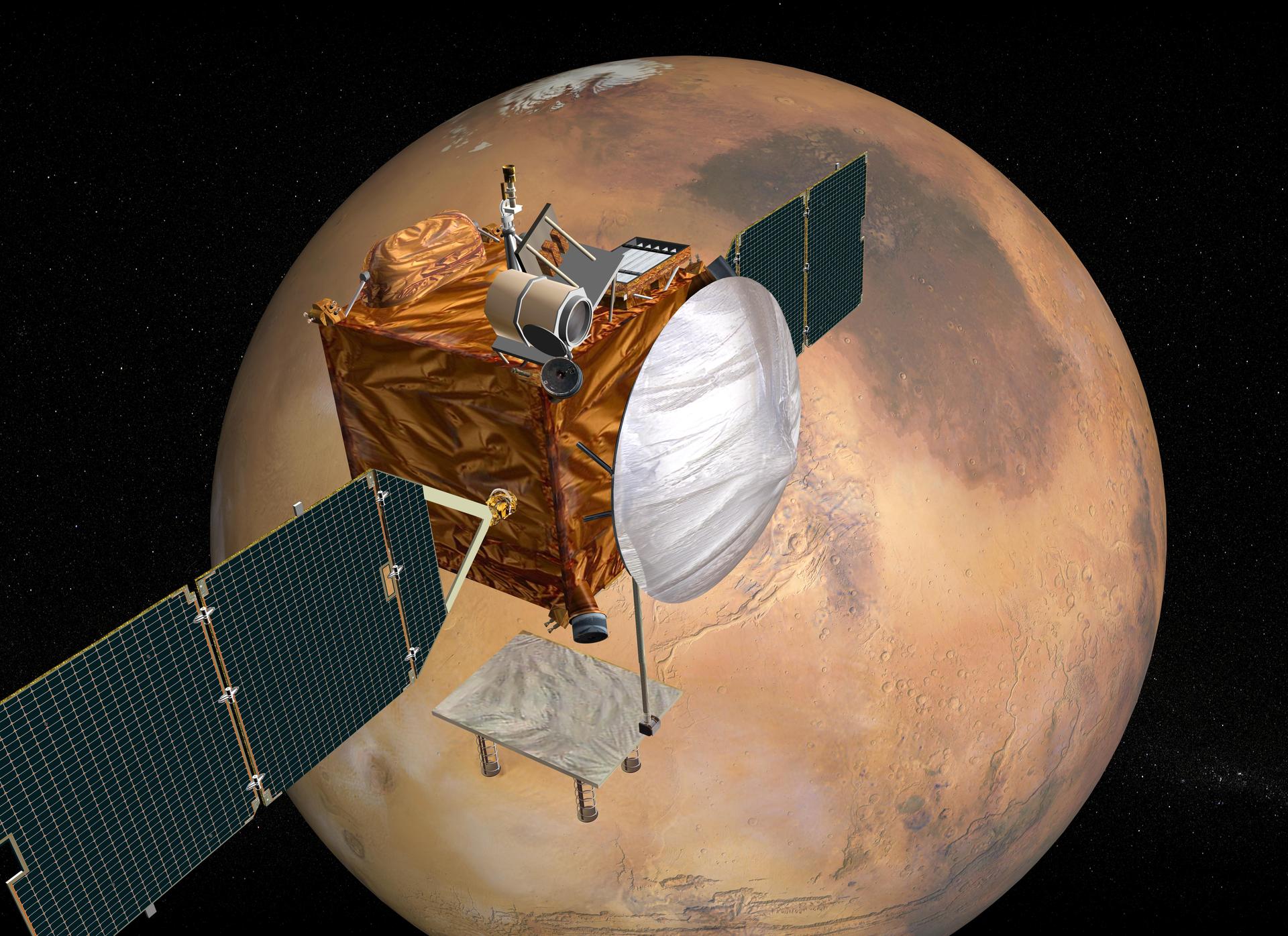
Managed by NASA’s Space Communications and Navigation (SCaN) program, the mission will deploy a high-capacity relay satellite designed to transmit high-resolution scientific data, high-definition imagery, positioning information, and critical command signals between surface assets on Mars and mission control on Earth. The procurement represents the first time the United States has contracted a private commercial provider to build and operate a primary communications backbone in orbit around another planet.
The formal award follows a competitive request for proposals issued by NASA in May 2026, which drew bids from commercial space firms including Rocket Lab and Blue Origin. The effort relies on dedicated funding appropriated by the United States Congress in July 2025, which mandated a competitively awarded, fixed-price commercial procurement to ensure long-term data relay capabilities for future Mars robotic exploration and eventual crewed expeditions.
According to NASA’s contract announcement, the initiative extends the agency’s commercial service model beyond low Earth orbit and the Moon into deep space. Blue Origin is expected to utilize its multipurpose “Blue Ring” orbital platform, which provides heavy payload hosting, high electrical power, and propulsion capabilities, adapting the bus for interplanetary transit and long-duration operations in Mars orbit.
Replacing an aging deep-space relay fleet
The award addresses a critical vulnerability in the international exploration of Mars. For more than two decades, surface missions such as the Curiosity and Perseverance rovers have relied on scientific orbiters to relay their data back to Earth. Direct transmissions from the Martian surface to Earth are severely constrained by antenna size and power limits, meaning nearly all scientific data, high-resolution photographs, and engineering telemetry must first travel via an orbiter overhead before beam transmission across interplanetary distances to NASA’s Deep Space Network.
However, the existing relay fleet is operating far past its original design lifetimes:
- 2001 Mars Odyssey: Launched in April 2001, Odyssey is the oldest continuously operating spacecraft at Mars, functioning for more than 25 years despite degraded reaction wheels and diminishing propellant margins.
- Mars Reconnaissance Orbiter (MRO): Launched in August 2005, MRO has served as the primary workhorse for high-volume data relay and landing-site reconnaissance for two decades, but faces ongoing battery aging and gyroscopic constraints.
- MAVEN (Mars Atmosphere and Volatile EvolutioN): In orbit since September 2014, MAVEN provides secondary relay coverage while carrying out atmospheric science.
- Mars Express and Trace Gas Orbiter: Operated by the European Space Agency (ESA), these spacecraft provide international relay support, but both face inevitable operational sunsets over the coming decade.
None of these legacy orbiters were designed primarily as dedicated telecommunications utilities; their relay duties have continually competed with onboard scientific observations and orbital pointing requirements. A dedicated telecommunications satellite eliminates this compromise, providing continuous, high-bandwidth data links optimized specifically for Martian surface assets.
As reporting by GovCon Wire highlights, the need for increased bandwidth will become acute as robotic sample return architectures and complex autonomous surface systems generate orders of magnitude more sensor data than previous generations of rovers.
Extending the commercial service model to deep space
The Mars Telecommunications Network contract marks a fundamental evolution in NASA’s procurement philosophy. Over the past fifteen years, NASA pioneered fixed-price commercial service contracts through the Commercial Orbital Transportation Services (COTS) and Commercial Resupply Services (CRS) programs for the International Space Station, later expanding the model to commercial crew flights and the Commercial Lunar Payload Services (CLPS) initiative for the Moon.
By extending this framework to interplanetary infrastructure, NASA avoids bearing the entire development risk and lifetime operating overhead of a bespoke government satellite. Under the firm-fixed-price structure, Blue Origin is compensated for delivering specified milestones, absorbing cost overruns while retaining ownership of the spacecraft platform architecture.
Industry reporting from Space and Defense emphasizes that the contract scope encompasses the entire mission lifecycle: spacecraft design, subsystem integration, launch, interplanetary cruise, orbital insertion, and up to five years of operational relay management around Mars. If successful, this commercial arrangement could establish a template for private infrastructure services throughout the inner solar system, allowing government space agencies to focus capital on instruments and scientific investigations rather than commodity communications hardware.
The award also cements Blue Origin’s growing role as an interplanetary contractor for NASA. In November 2025, Blue Origin launched NASA’s twin ESCAPADE (Escape and Plasma Acceleration and Dynamics Explorers) spacecraft toward Mars aboard its heavy-lift New Glenn rocket, proving the operational mechanics of commercial planetary transit.
Technical hurdles and schedule constraints
Deploying a commercial communications orbiter to Mars by the end of 2028 presents formidable engineering and operational challenges. Interplanetary launch windows between Earth and Mars open only once every 26 months when the planets align, creating an unforgiving deadline:
- Tight development schedule: Blue Origin has approximately 28 months from contract award to complete spacecraft manufacturing, payload integration, environmental testing, and final delivery by 31 December 2028.
- Launch vehicle availability: The mission is intended to fly aboard Blue Origin’s New Glenn launch vehicle. Following a launchpad incident in May 2026, Blue Origin has been working to restore its Cape Canaveral launch infrastructure, with executive leadership aiming for full pad recertification by late 2026. Meeting the late-2028 Mars departure window will require uninterrupted flight operations and steady production of BE-4 engines.
- Orbital insertion and longevity: Once the spacecraft reaches Mars in late 2029 or early 2030, it must execute a high-delta-v orbital insertion burn and circularize its orbit. The spacecraft must maintain reliable autonomous operation in the harsh Martian radiation and thermal environment for a minimum baseline mission of five years, with potential extensions into the mid-2030s.
According to coverage by Xinhua News Agency, international space analysts regard the delivery timeline as one of the most ambitious deep-space procurement schedules ever attempted by a commercial contractor.
What is still uncertain
While the contract establishes the budget ceiling and target milestones, key operational and technical details remain to be resolved during the preliminary design review phase:
- Communications payload specifications: NASA and Blue Origin have not yet disclosed the exact breakdown between traditional radio frequency (X-band and Ka-band) transceivers and experimental deep-space optical (laser) communications terminals. Optical communications could increase data transfer rates by a factor of 10 to 100, but require precise pointing systems that must pierce Earth and Martian atmospheric conditions.
- Interoperability and open standards: It remains to be detailed how the Blue Origin orbiter will interface with international spacecraft from ESA, JAXA, and commercial landers. NASA has committed to Consultative Committee for Space Data Systems (CCSDS) standards, but technical coordination on relay protocols and scheduling priority is ongoing.
- Contingency plans for legacy orbiters: If delivery slips past the 2028 planetary window, the next transit opportunity would not occur until early 2031, leaving NASA dependent on Odyssey and MRO for an additional two to three years. Flight controllers at the Jet Propulsion Laboratory continue to implement conservation measures to extend the lifespan of existing orbiters.
The selection of Blue Origin represents a decisive commitment to modernize the communication links of Mars exploration. Over the next two years, the execution of the contract will determine whether commercial fixed-price frameworks can reliably sustain the infrastructure of interplanetary science.