Reporting snapshot · 22 November 2026 (Asia/Karachi). The plenary that would approve the text had not opened when this was filed, and the text can still be amended before adoption. The wording and figures below describe the draft as circulated to delegates early on Sunday; if consensus fails, the outcome may be no agreement at all.
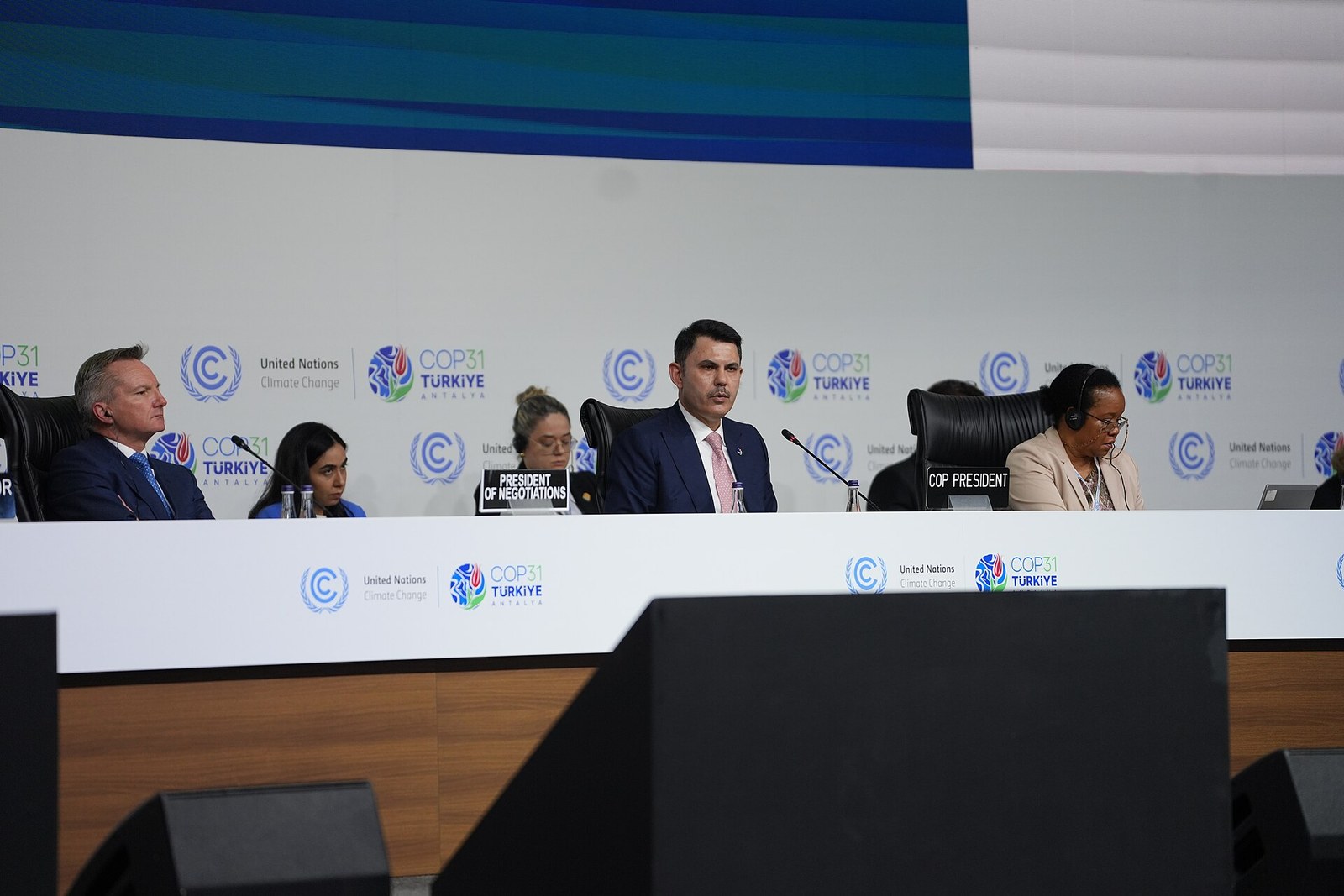
Delegates at the United Nations climate summit in Antalya received a third and final version of the summit’s cover decision in the early hours of Sunday, and the closing plenary that would adopt it slipped from 9am to 11am in Antalya, which is 1pm Pakistan time, as objections grew. The text itself has now been published officially: 94 paragraphs, under the symbol DT.CMA8.i2c.1, and the Guardian’s live coverage recorded that members of the coalition pressing hardest for fossil fuel language were “unhappy with the new text”.
The compromise at the centre of it is a sentence that says nothing and everything. The draft opens by recalling the agreement reached at COP28 in Dubai three years ago “in its entirety, across mitigation, adaptation and means of implementation”. That agreement — the UAE Consensus — was the only UN climate cover decision ever to contain the phrase “fossil fuels”. The new text never uses those words, and the BBC reported that it instead acknowledges the commitment countries made three years ago. Delegates saw it for what it was: a bridge built to get a deal over the line without putting the phrase back in. It is the one substantive change KhabarWire’s report on Friday’s overtime had predicted the presidency would have to find.
The compromise on carbon capture and electrification
Two of the objections that stopped the talks on Thursday have been answered, in opposite directions. The Guardian reported that the latest draft removed a hard numerical target for carbon capture, utilisation and storage; the text now describes accelerating it “with an aim to achieve gigatonne scale globally by 2035 as a collective global aspiration”. The 35 per cent goal for electricity’s share of global final energy consumption by 2035, which the Thursday draft had weakened, is back in, alongside language recognising that electrification’s contribution to the Paris temperature goal “is maximized with the greatest possible use of clean energy”.
The summit’s own draft text is unusually blunt about what it concedes. It states deep concern that “peak global warming is expected to exceed 1.5 °C above pre-industrial levels in the next few years”, and the BBC reported that this is the first time at a COP that the agreement, known officially as the Antalya Accords, acknowledges the 1.5°C goal set in Paris will be missed.
Saudi Arabia’s red lines, and a threat of a forced vote
The Saudi position has not moved. The Guardian reported that Saudi Arabia refused to drop its demand that carbon capture be strongly recommended, and still refuses any reference to a “transition away from fossil fuels” — and that the European Union is considering forcing a plenary at which Saudi Arabia must either accept the consensus or oppose it publicly, a step the Guardian noted is risky because Saudi Arabia’s allies could hold out. A diplomat from the coalition pressing for fossil fuel language told the Guardian there had been “a stitch up between the presidency and Saudi Arabia”, with one side getting the electrification target and the other the carbon capture target.
Others are preparing to block. Panama’s environment minister, Juan Carlos Navarro, said his country would formally object to any agreement failing to include fossil fuel language, and UN News noted that because decisions are taken by consensus, a single formal objection can block adoption. One hundred civil society groups told the co-hosts in a letter on Saturday that they were “on course to preside over one of the most disappointing COPs” the UN has ever held, Al Jazeera reported, warning that only hours remained “to save this COP from becoming a low point of three decades of climate negotiations”.
Adaptation finance without a number
The missing money is the part Pakistan came for. The $120 billion adaptation-finance target that developing countries had pushed for is not in the text. In its place the draft asks the Standing Committee on Finance to identify options for the baseline of the tripling goal in a report for next year’s session, and agrees to discuss an implementation pathway at the same time — deferring both to November 2027. The text does record the scale of the gap, estimating developing countries’ adaptation finance needs at $305 billion a year to 2035, and the BBC reported that the African Group’s proposal was not even accepted for formal negotiation.
The secretary-general’s verdict on what tripling would buy has not changed. António Guterres said at his final COP press conference that “even tripling adaptation finance would meet less than 30 per cent of what is needed”, UN News reported, and he has urged governments to tax the windfall profits of fossil fuel companies. Ghana’s environment minister, Zanetor Agyeman Rawlings, chair of the African Group, put the position bluntly: “We did not come here to beg, we came here to claim what is rightfully ours for our people who are suffering the brunt of anthropogenic activities of developed countries”, the BBC reported.
What the text leaves for Pakistan
Pakistan came to Antalya pressing for grant-based climate finance rather than new debt, and for faster disbursement from loss-and-damage funds, as KhabarWire reported at the summit’s opening. Losing the $120 billion figure does not cancel money already pledged, but it removes the benchmark adaptation planners would have worked to. The restored electrification goal, tied again to clean energy, cuts the other way: it makes new generation capacity built on gas or coal harder to count toward the target Pakistan is trying to meet.
The energy shock running through the summit sharpens that arithmetic. The News International reported that the International Energy Agency has warned prolonged Strait of Hormuz fuel disruptions stemming from the war in Iran would intensify the push to transition to clean energy. On Sunday, Pakistan’s climate change minister met Nepal’s culture, tourism and civil aviation minister in New Delhi on the sidelines of the first Shanghai Cooperation Organisation Civilisations Dialogue Forum, where Radio Pakistan reported that Musadik Malik expressed grief over the lives lost in recent floods in Nepal and stressed that urgent global action is essential.
The plenary that has to find a quorum
Under the climate convention’s rules of procedure two-thirds of parties must be present for decisions to be made, which the Guardian put at 132 of 198 parties to the convention and 130 of 194 to the Paris Agreement. The BBC reported that negotiating teams with Sunday morning flights rescheduled them on Saturday, and Reuters reported that the United States, the largest historical emitter, has been absent for a second year running. The EU’s climate commissioner, Wopke Hoekstra, said the summit would “either produce a good deal or no deal at all”.
Two outcomes are live. The text is adopted, with an oblique fossil fuel reference, a softer carbon capture paragraph and no adaptation figure. Or consensus fails and the talks are suspended, the outcome the European Union’s climate commissioner warned of, and the one Gulf states can still force if their allies hold. The test for Pakistan is not whether Antalya produces a headline, but whether the text contains a number that adaptation planners in the Indus basin, the floodplains of Punjab and the drought districts of Balochistan can budget against.