Reporting snapshot · 10 November 2026 (Asia/Karachi). The air-service plan is a proposal announced after a meeting between Gilgit-Baltistan's chief minister and Khyber Pakhtunkhwa's governor. No lease agreement, aircraft type, route schedule, cost or guarantee terms have been published, and the boundary talks have no timetable.
What happened
Gilgit-Baltistan Chief Minister Amjad Hussain and Khyber Pakhtunkhwa Governor Faisal Karim Kundi met on 8 November and agreed to explore a joint venture with the private carrier South Air to improve air links to Gilgit-Baltistan, The News reported. Under the proposed arrangement, aircraft would be leased against a guarantee from the Gilgit-Baltistan government and South Air would operate the flights, The Express Tribune reported.
The two accounts agree on the core outline but describe the sequence slightly differently. The News says the understanding was reached in the meeting between the two leaders. The Express Tribune says the proposal was discussed in a meeting between Mr Hussain and South Air management, and that the matter also emerged in his meeting with Governor Kundi. Neither report says whether a memorandum, term sheet or formal cabinet decision exists.
The meeting also covered two other issues. Mr Hussain asked for training in Peshawar for staff of the Gilgit-Baltistan Testing Service, and the two leaders agreed that long-standing boundary disputes between Gilgit-Baltistan and Khyber Pakhtunkhwa would first be taken up by their chief secretaries and then referred to the political leadership, according to The News. The Express Tribune reported the same sequence.
Why Gilgit-Baltistan’s air link matters
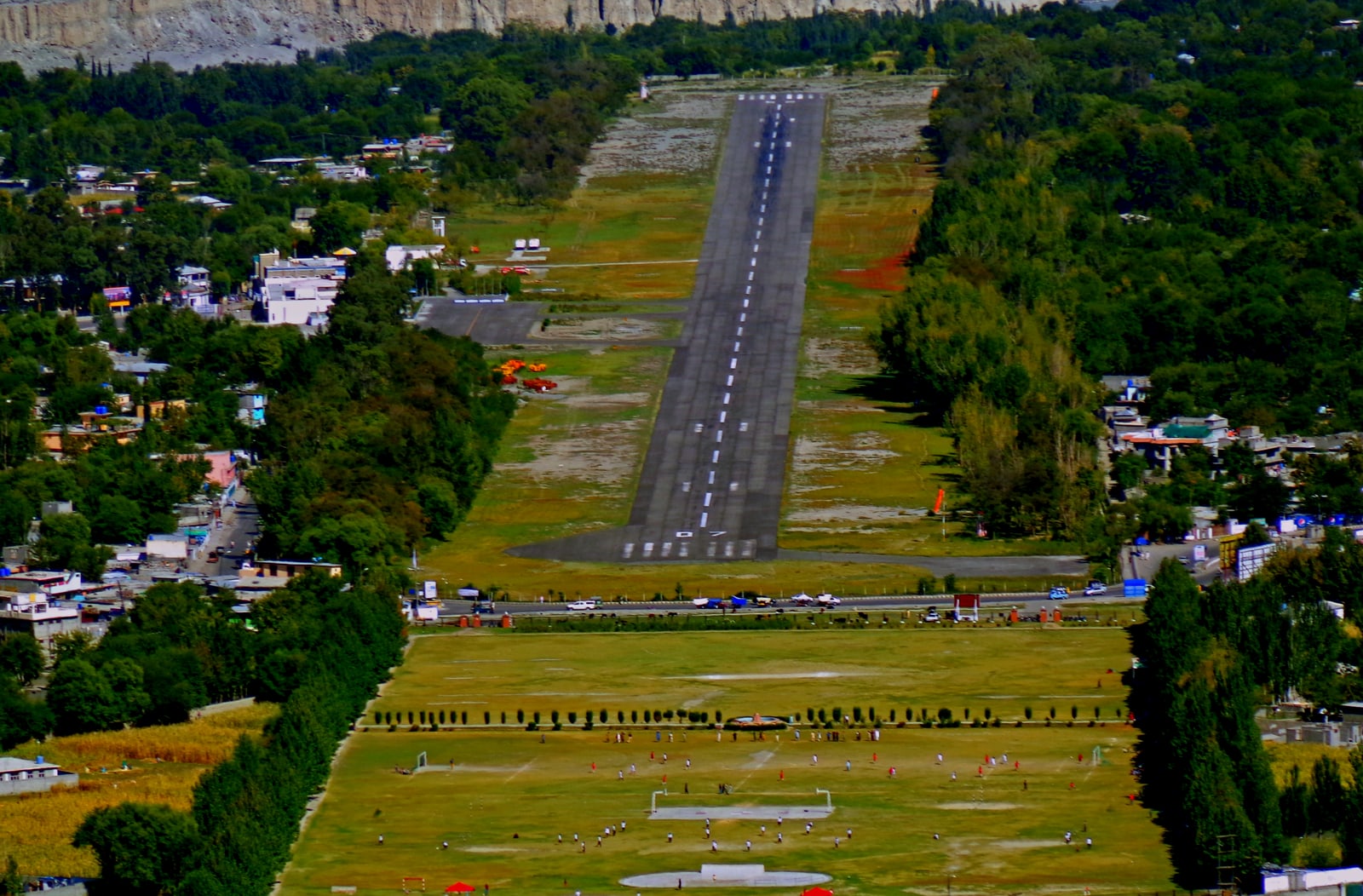
Air travel is an important means of transport for residents and visitors in Gilgit-Baltistan, and the region’s flights are particularly vulnerable to weather disruption, The Express Tribune reported. The same report set out the physical constraint: Gilgit Airport’s runway is about 1,646 metres long, which limits operations to smaller turboprop aircraft such as the ATR.
The passenger figures show how far Gilgit lags behind the region’s other main airport. Between March and June 2026, Gilgit Airport handled around 4,000 passengers, compared with more than 50,000 at Skardu Airport over the same period, according to The Express Tribune. In June 2024, PIA flight disruptions during the peak tourism season prompted the then chief minister to seek federal intervention. In 2025, PIA cancelled six flights to and from the northern areas, including five Islamabad-Gilgit services and one Islamabad-Skardu flight, the newspaper reported.
KhabarWire has previously reported on PIA’s route cuts and fare changes as jet fuel costs rose, and on the formation of the current Gilgit-Baltistan government after the June 2026 election. Both are part of the backdrop: a thin aviation market, high operating costs and a provincial government with limited fiscal room.
The lease-guarantee model, and its risks
The proposed structure shifts the upfront capital burden away from the airline. The Gilgit-Baltistan government would provide a guarantee so that aircraft can be leased, while South Air would operate the flights. That can make sense where a private carrier is unwilling to commit to a route with uncertain demand, because the guarantee lowers the lessor’s risk.
But a guarantee is not free money. It is a contingent liability. If the venture misses payments, the provincial government could be exposed. The reports do not say how large the guarantee would be, how many aircraft would be leased, what type they are, how long the lease would run, or who would bear maintenance, fuel and insurance costs. They also do not say whether the arrangement would be procured through a competitive process or negotiated directly with South Air.
Those details matter in a region with a small tax base and a large development bill. A lease guarantee could improve connectivity if demand holds and the operator performs. It could also leave the government paying for aircraft it does not control if traffic falls short. The absence of published terms means the fiscal risk cannot yet be assessed.
There are regulatory questions too. Any new scheduled service would need route approvals and safety oversight, and the airline must have the aircraft and crew to operate reliably. South Air’s domestic network and operating record are not described in either report, and its ability to sustain a Gilgit operation through the weather season is not established.
The boundary dispute track
The boundary issue is separate from aviation but politically sensitive. The reports describe long-standing boundary demarcation disputes between Gilgit-Baltistan and Khyber Pakhtunkhwa, but do not identify the specific segments under discussion or say whether any maps, surveys or legal claims have been exchanged.
What is new is the agreed process. The chief secretaries of the two regions will examine the disputed matters first, and the political leadership will take them up afterwards, according to The News. That is a low-key, administrative route rather than a public negotiation. It may suit both governments because it avoids committing either side to a particular map before the technical work is done. But it also means there is no deadline, no published terms of reference and no guarantee that the talks will produce a settlement.
The reports do not set out what is at stake for residents, how a settlement would affect land or taxation, or whether the chief secretaries have met yet. Those omissions make the process difficult to assess beyond its stated aim of resolving the disputes through consultation.
What is still uncertain
The most important unknowns are contractual. No lease agreement has been signed, no aircraft type or number has been disclosed, and no route schedule or launch date has been announced. The guarantee’s size, duration and conditions are unpublished. It is not clear whether the Gilgit-Baltistan cabinet has approved the proposal, whether the provincial assembly will scrutinise it, or whether the federal government has been asked to back the guarantee.
The boundary talks are equally open. The chief secretaries’ mandate, the disputed areas and the timetable have not been made public. It is not known whether the two sides will accept arbitration or a survey, or whether the process will include local communities.
There is also a commercial question. A government guarantee can attract an operator, but it does not create year-round demand. Gilgit’s weather, the short runway and the availability of smaller aircraft will continue to shape the service. The plan’s success will depend on whether South Air can operate reliably in conditions that have disrupted larger carriers, and whether the provincial government can afford the guarantee it is offering.
What happens next
The immediate next steps are administrative. The chief secretaries of Gilgit-Baltistan and Khyber Pakhtunkhwa are expected to take up the boundary issues, and the Gilgit-Baltistan government and South Air are expected to work out the lease and operating terms. Any launch would require regulatory approvals and a published schedule.
For now, the announcement is a statement of intent, not a completed deal. The test will be whether it is followed by a signed agreement with transparent terms, a realistic route plan and a boundary process that produces more than another round of consultations.