Reporting snapshot · 14 October 2026 (Asia/Karachi). This account rests on the Finance Ministry's official X account posts dated 14 October; on The Express Tribune's 14 October report from Bangkok drawing on the same Ministry statement; on Profit by Pakistan Today's 14 October report from Bangkok; and on the IMF's October 2026 World Economic Outlook for the broader macro context. The "22-year low" fiscal deficit framing is the government's own claim; the underlying fiscal data are official Ministry of Finance and State Bank of Pakistan statistics, but the specific 22-year benchmark has not been independently verified in the materials available at publication time.
What the finance minister said in Bangkok
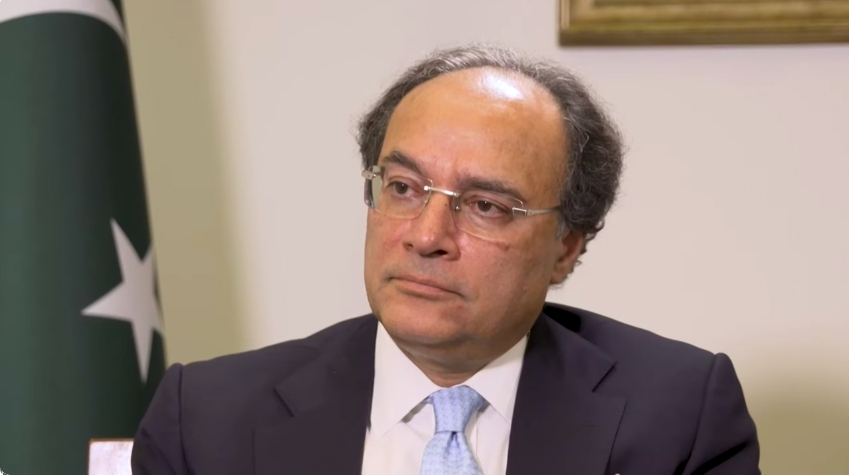
Finance Minister Muhammad Aurangzeb told investors and the IMF in Bangkok on 14 October that Pakistan’s fiscal deficit had fallen to a 22-year low, that the country had run three consecutive years of primary surpluses, and that growth could reach or exceed 4 per cent in the current fiscal year, per the Finance Ministry statement on its official X account. Aurangzeb delivered the message at a Citi Macro Forum session, a Standard Chartered sovereign-investor roundtable and a Jefferies roundtable, as The Express Tribune reported from Bangkok. Profit by Pakistan Today carried the same statement and added its own summary of the Jefferies, Citi, Barclays and Standard Chartered roundtables.
Three years of primary surpluses — fiscal balances excluding interest payments — driven by tax-base expansion, stronger enforcement and provincial coordination, are exactly the trajectory that supports a sovereign rating upgrade.
The new financing strategy
Three concrete financing actions were attached to the macro narrative. Aurangzeb said Pakistan would repeat the Panda bond programme, tap the Sukuk market and prepare a rupee-denominated, dollar-settled international bond that would for the first time marry an emerging-market issuer’s domestic-currency liability to a hard-currency settlement, per Profit’s summary of the roundtables. The Panda bond itself is not new — Pakistan tapped the Chinese renminbi market in mid-May with a three-year RMB 1.75 billion note at 2.5 per cent, as KhabarWire reported. Aurangzeb confirmed on 12 October that the programme would be repeated, per KhabarWire’s 14 October G-24 article. The rupee-denominated dollar-settled bond is the novel element.
In a separate S&P Global Ratings meeting, Aurangzeb pitched Pakistan as a double-B credit story — a step up from its current single-B placement — citing the September Eurobond, three years of primary surpluses and the 7 October staff-level agreement on the fourth review of the $7 billion Extended Fund Facility, per the Tribune’s account of the S&P dialogue. The September Eurobond raised $3 billion in a record dual-tranche sale, as KhabarWire reported on 3 September.
What the macro backdrop implies
The 22-year-low deficit claim lands in a frame the IMF published on 13 October at the same meetings. The IMF’s October 2026 World Economic Outlook raised Pakistan’s inflation forecast for FY2026-27 to 9.9 per cent from 8.4 per cent, kept the growth projection at 3.5 per cent, and raised the current-account deficit estimate to about 1 per cent of GDP — roughly $4.4 billion, per the IMF’s outlook page. KhabarWire covered those numbers on 13 October, noting the IMF’s growth sat 0.5 percentage points below the government’s 4 per cent target and the inflation forecast 1.7 percentage points above the 8.2 per cent target, in the dedicated 13 October article.
The two pictures partly fit. Three years of primary surpluses, a falling headline deficit and a record Eurobond are exactly what the fund wants in a country under a $7 billion Extended Fund Facility, per the 8 October SLA coverage. Pakistan’s statistics office reported 10.3 per cent year-on-year headline inflation in September, per KhabarWire’s October CPI report. The two pictures can coexist only if September’s pace cools and the IMF’s slower growth path does not weaken the revenue base driving the surpluses.
What is still uncertain
Three questions remain open.
The first is the “22-year low” benchmark itself. The Ministry of Finance did not publish a year-by-year comparison, and the IMF’s October outlook does not break the deficit history out by year. The framing rests on the ministry’s own presentation; the underlying fiscal data are official, but the specific 22-year benchmark has not been independently audited. Both The Express Tribune and Profit by Pakistan Today attributed the language to the Finance Ministry statement.
The second is the timing of any sovereign rating action. S&P does not publish ratings on a daily schedule, and the upgrade to double-B is an ambition, not a decision. The September Eurobond, the November IMF Executive Board review and the SLA’s prior actions all need to clear first.
The third is the financing mix. The Panda bond and Sukuk pipelines exist, the rupee-denominated dollar-settled bond is a proposal, but pricing, tenors and order books have not been disclosed. The Baa3-by-Moody’s rating from August 2025 was the most recent sovereign upgrade, as KhabarWire reported; the path to double-B depends on execution.
Sources & reporting notes
This is a synthesis of published material, not eyewitness reporting. Sources were reviewed on 15 October 2026 (Asia/Karachi). The "22-year low" framing is attributed to the Finance Ministry's own presentation; the underlying fiscal data are official and verifiable, but the specific benchmark was not independently audited before publication. The English-language and Pakistan outlets below carried the same ministry statement in two parallel dispatches from Bangkok.
- Finance Ministry of Pakistan (@Financegovpk) — Aurangzeb highlights macroeconomic stabilisation, capital market strategy and reform priorities at Citi Macro Forum14 October 2026 · The ministry's own read-out of Finance Minister Aurangzeb's remarks at the Citi Macro Forum, the 14 October primary record for the 22-year-low fiscal deficit and the 4 per cent-plus growth ambition.
- The Express Tribune — Aurangzeb says Pakistan's fiscal deficit falls to 22-year low14 October 2026 · Independent Pakistan outlet reporting from Bangkok on the Citi, Standard Chartered, Barclays and Jefferies roundtables, the S&P dialogue, the MENAP meeting, the US State Department Yon meeting, and the Reko Diq, IFC and digital-asset strands.
- Profit by Pakistan Today — Pakistan expects GDP growth at 4% or higher in FY27, plans new bonds to diversify financing sources, says finance minister14 October 2026 · Independent Pakistan financial outlet's parallel dispatch from Bangkok on the same Citi, Standard Chartered, Barclays and Jefferies roundtables, with expanded detail on the S&P dialogue, Panda bond and Sukuk pipelines and the rupee-denominated dollar-settled bond proposal.
- International Monetary Fund — World Economic Outlook, October 2026Released 13 October 2026 · Primary multilateral record published at the same annual meetings, used here for the broader macro context: the 9.9 per cent FY27 inflation forecast, the 3.5 per cent growth projection, the 1 per cent of GDP current account deficit and the Middle East and Central Asia regional revisions.
- KhabarWire — IMF raises Pakistan's FY27 inflation outlook to 9.9% and holds growth at 3.5%13 October 2026 · Internal archive of the 13 October IMF release, used here to anchor the gap between the IMF's 3.5 per cent growth projection and the government's 4 per cent-plus target.
- KhabarWire — Pakistan reaches IMF staff-level agreement on fourth EFF and third RSF reviews8 October 2026 · Internal archive of the 7–8 October fourth-review staff-level agreement, used here to explain the SOE-law package and the statistical-discrepancy discussion that S&P said must clear before a rating action.
- KhabarWire — Pakistan raises record $3bn in single Eurobond sale3 September 2026 · Internal archive of the record $3 billion dual-tranche Eurobond issuance, used here as the September capital-market entry Aurangzeb cited to S&P and the broader investor base.
- KhabarWire — Pakistan's debut Panda bond oversubscribed five times15 May 2026 · Internal archive of the inaugural RMB 1.75 billion Panda bond issuance, used here to explain the "repeat Panda" language Aurangzeb repeated to investors in Bangkok.
Sourcing note. The Express Tribune and Profit by Pakistan Today both rewrote the Finance Ministry's own statement in two parallel dispatches from Bangkok; the Tribune carried the Standard Chartered and S&P-specific wording first, while Profit carried the Citi, Jefferies and Barclays detail and the institutional investor pipeline. The "22-year low" framing is the ministry's own language, neither outlet independently audited the 22-year benchmark, and the IMF WEO's October 13 release provides the broader macro context rather than the 22-year figure itself. The English-daily landscape: Dawn, Geo and The News International did not publish their own dispatch from the 14 October Bangkok investor day before this article closed for review.