Reporting snapshot · 12 October 2026 (Asia/Karachi). This account rests on an on-the-record interview that Finance Minister Muhammad Aurangzeb gave to Reuters in Bangkok on Monday 12 October, on the sidelines of the IMF and World Bank annual meetings. The interview was carried by several outlets but has not been independently re-reported, so the forecasts and figures below are the minister's own claims and have not been separately verified by KhabarWire. No privatisation transaction described here has been notified, agreed or completed, and the government has not published a transaction timetable.
What Aurangzeb said in Bangkok
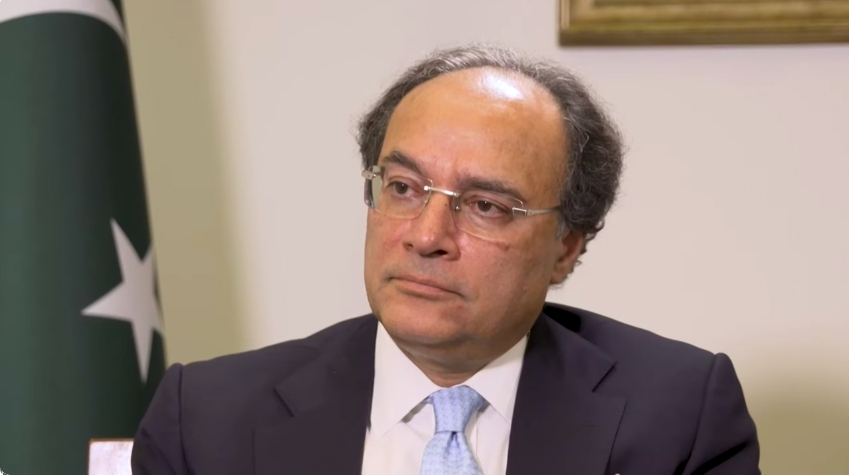
Finance Minister Muhammad Aurangzeb said on Monday 12 October that Pakistan’s economy should grow by more than 4% this fiscal year despite elevated oil prices, and that the government aims to sell five to six state-owned entities that could raise upwards of $1 billion. He made the remarks in an interview with Reuters on the sidelines of the annual meetings of the International Monetary Fund (IMF) and the World Bank in Bangkok, as Geo News reported.
“So I’m still quite clear that we should clock north of 4%,” Aurangzeb told the wire service, adding that on inflation “obviously, we are keeping a very close eye because it does have a knock-on impact in terms of the commodity prices.”
The minister said Pakistan had been able to procure adequate quantities of fuel and had avoided shortages, and that critical sectors such as agriculture were holding up. He framed the economy as one that is “highly vulnerable” to a prolonged Middle East conflict because of its dependence on Gulf energy imports, remittances and financing support from the region, and because it still relies on external financing to bolster foreign-exchange reserves and meet debt repayments.
Why the growth call matters
The forecast is the finance ministry’s own, delivered while the IMF and World Bank hold their 2026 annual meetings outside Washington for the first time in three years. Those meetings opened on 12 October with a warning from IMF Managing Director Kristalina Georgieva that artificial intelligence could augment, downgrade or eliminate about 40% of jobs over time, as KhabarWire reported from the opening plenary.
For Pakistan, the more immediate backdrop is the programme that underwrites the macro numbers. Pakistan reached a staff-level agreement with the IMF that would unlock about $1.21 billion under its $7 billion, 37-month Extended Fund Facility and an associated climate programme, announced on 8 October. The agreement still needs the IMF’s Executive Board, and the Fund has tied its support to revenue and state-enterprise measures that include raising tax revenue on farm income — one of the “tough measures” Aurangzeb referred to in the interview.
A growth outcome above 4% would sit above the Fund’s recent projections and would matter for a labour market that has been weak. Pakistan’s GDP growth and inflation path through the fiscal year will also shape the State Bank of Pakistan’s next monetary-policy decision, which market analysts expect later this month.
The privatisation pipeline
The centrepiece of the interview was privatisation. Aurangzeb said that after the sale of Pakistan International Airlines, the government has around another dozen entities in the pipeline, including state-owned power distribution companies and the outsourcing of airport operations.
“I expect about five or six of these to go through during this fiscal year,” he said, adding that they could raise more than $1 billion. The minister presented the programme as a test of the government’s direction rather than a one-off transaction: “We are quite clear that we want the private sector to lead the country. So our role is to help support, assist any way we can in terms of the ecosystem.”
Privatisation has been cast by officials and the Fund as a key test of Pakistan’s reform credibility, with the argument that failing to offload loss-making state firms risks renewed pressure on public finances. The power distributors are the most sensitive part of that agenda: Pakistan has told the IMF it will sell nine distribution companies by the end of December 2027 in four batches, excluding the loss-making Quetta company, as KhabarWire reported on 5 October. The finance minister’s $1 billion figure spans a wider set of assets than the DISCOs alone, including airport operations, but he did not name the specific five or six transactions he expects to close.
A proposed US exchange stabilisation facility
A second thread was external financing. Aurangzeb said Pakistan is continuing discussions with the United States over a proposed $10 billion exchange stabilisation facility, and that the talks are separate from ongoing engagement with the Export-Import Bank of the United States (EXIM) and the US International Development Finance Corporation (DFC). He declined to give a time frame.
“If it comes through, this will be a great help for us,” he said. “If it doesn’t come through, this does not, you know, create any problem for us in terms of access to market.”
That caveat matters because the facility would be a financing buffer rather than a programme condition. Pakistan has relied on a mix of IMF disbursements, Gulf deposits and bilateral rollovers to keep reserves steady, and a US facility of that size would be large relative to the roughly $1.21 billion the Fund’s fourth review is set to release. Its status was not otherwise confirmed by either government in the interview, and no text or term sheet has been published.
What is still uncertain
Several claims in the interview remain unverified and open. The growth forecast above 4% is a government projection; the IMF’s updated World Economic Outlook, due on 13 October, will give the first Fund-side number since July and may differ. The privatisation pipeline is a list of intentions, not signed transactions: the finance minister did not identify which five or six entities he expects to sell this fiscal year, and the DISCO process has already been pushed back once, with the deadline now December 2027.
The US exchange stabilisation facility is described by the minister as under discussion with no agreed time frame and no published terms, so its size, conditions and likelihood cannot be assessed from the interview alone. And all of the reporting above traces to a single Reuters interview carried by multiple outlets; KhabarWire has not been able to corroborate the numbers from a second, independent line of reporting. That limitation is material to how firm the $1 billion and above-4% figures should be treated.
Sources & reporting notes
This is a synthesis of published material, not eyewitness reporting. Sources were reviewed on 12 October 2026 (Asia/Karachi).
- Geo News — Pakistan eyeing over $1bn from privatisation of 5-6 entities, says finance czar12 October 2026 · Full text of the Reuters interview with Finance Minister Muhammad Aurangzeb, carrying his above-4% growth forecast, the five-to-six entity privatisation plan worth more than $1bn, the roughly dozen-entity pipeline, the continued talks on a proposed $10bn US exchange stabilisation facility, and his quotations on inflation and the private sector.
- The Express Tribune — Pakistan sees growth above 4%, looks to raise more than $1 billion from privatisation12 October 2026 · Second allowlisted outlet carrying the same Reuters interview, corroborating the growth forecast, the privatisation figure and the description of the state-owned power distributors and airport operations in the pipeline.
- Reuters — Pakistan sees growth above 4%, looks to raise more than $1 billion from privatisation12 October 2026 · The originating wire dispatch of the on-record interview in Bangkok; the wire text could not be retrieved directly at the time of writing and is cited through the two outlets above, so all three sources share a single origin.