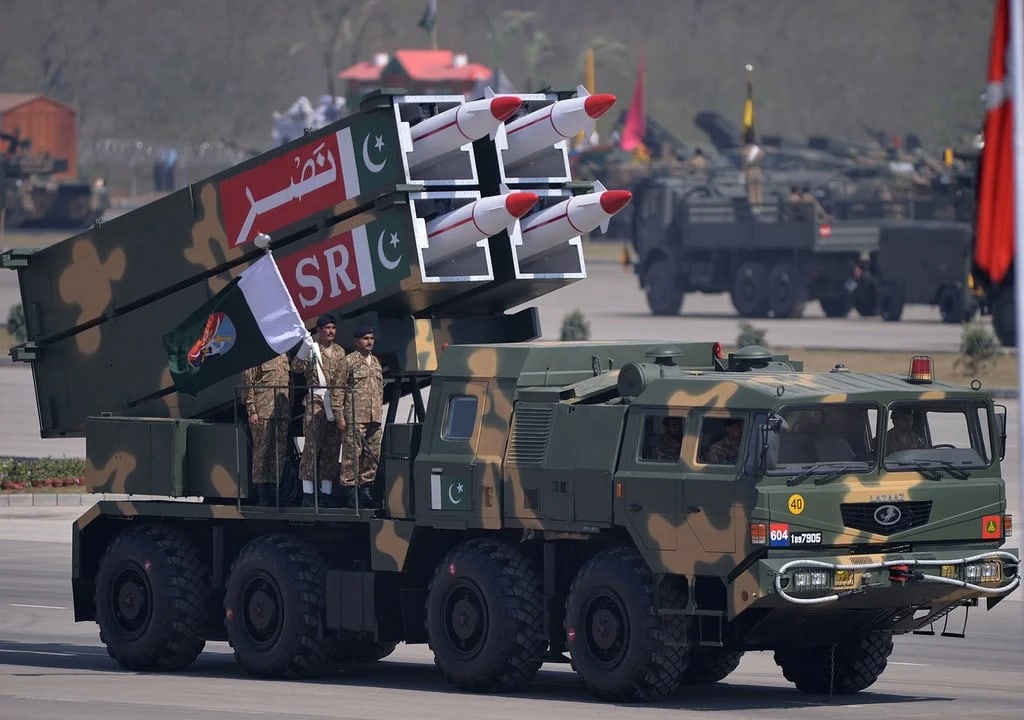
Reporting snapshot · 13 October 2026 (Asia/Karachi). Pakistan's military announced on Tuesday that it had test-launched an extended-range Fatah-2 hypersonic ballistic missile. This account rests on the Inter-Services Public Relations statement and same-day reporting by Dawn, The Express Tribune and Geo News. The range, speed and flight profile of the weapon are the military's own claims and have not been independently verified.
What happened
The Pakistan Army conducted a successful test launch of the Fatah-2 Extended Range (ER) hypersonic ballistic missile on Tuesday, 13 October 2026, the military’s media wing said. In a statement, Inter-Services Public Relations (ISPR) said the weapon system was equipped with “advanced navigation and state-of-the-art avionics”.
“It is capable of engaging targets with high precision and defeating [the] enemy’s missile defence systems due to its unique trajectory and manoeuvrability features,” ISPR said, according to Dawn. “Fatah-2 ER, with its extended range, will further enhance [the] army’s reach and capability of engaging deep targets.”
The launch was witnessed by the commander of the Army Rocket Force Command (ARFC), named by Dawn as Lt Gen Nauman Zakaria, along with senior army officers and the scientists and engineers associated with the programme. ISPR said the commander “appreciated the dedication and technical prowess of scientists and engineers”. President Asif Ali Zardari, Prime Minister Shehbaz Sharif, Chief of Army Staff and Chief of Defence Forces Field Marshal Asim Munir, and the service chiefs congratulated the team, while Interior Minister Mohsin Naqvi congratulated the nation and called the test an important advance in the defence sector.
What ‘hypersonic’ means here
Hypersonic generally describes flight at speeds above Mach 5, five times the speed of sound. In the sense the military has adopted, it also implies a weapon that can manoeuvre in flight rather than follow a predictable ballistic arc. ISPR’s language maps onto that second meaning: it emphasised a “unique trajectory and manoeuvrability” and the ability to defeat “enemy missile defence systems”. A manoeuvring, high-speed re-entry vehicle is harder for air-defence and missile-defence radars to track and intercept than a conventional ballistic missile on a fixed course.
That is the claim, not an established fact. ISPR published no speed, range, altitude or flight-path data, and no foreign government or open-source monitoring group had published an independent assessment at the time of writing. The “hypersonic” description is the Pakistan Army’s own; readers should treat the performance claims as the military’s, pending verification.
How the Fatah-2 ER fits the Fatah programme
The Fatah, also spelt Fateh, family is a set of conventionally armed, ground-launched weapons developed for the Pakistan Army and operated through the Army Rocket Force Command. The earlier Fatah-1 and Fatah-2 are guided rocket systems, while the Fatah-4, tested in an extended-range form on 6 October, is a terrain-hugging cruise missile designed to fly low to evade defences. The Fatah-2 ER announced on Tuesday is a ballistic rather than a cruise weapon, and the “extended range” suffix indicates a longer-reach version of the existing Fatah-2.
The test continues an unusually active run of missile announcements by Pakistan’s armed forces in 2026. The extended-range Fatah-4 cruise missile was test-launched on 6 October, a week before Tuesday’s launch; the Army Rocket Force Command conducted a training launch of the Fateh-II system on 28 April; and the air force flight-tested the Taimoor air-launched cruise missile in January. The Fatah programme is presented by the military as locally designed and produced rather than imported.
Why it matters
Pakistan has long said its missile programmes are defensive and India-specific, part of a posture it calls credible minimum deterrence. A conventionally armed, longer-range ballistic system gives army planners a ground-launched option to strike targets at greater depth without depending on aircraft penetrating air defences, the same rationale the military gave for the extended-range Fatah-4. The claim that the Fatah-2 ER can defeat missile defences speaks to the India-Pakistan conventional balance at a time of continued tension over Kashmir, water sharing and cross-border militancy.
As with the Fatah-4 test a week earlier, the military did not link this launch to any specific event or adversary. The announcement is best read as a capability statement rather than a response to a particular incident, and it reinforces the army’s message of steady investment in indigenously produced precision-strike systems.
What is still uncertain
The central unknowns are technical and operational. ISPR disclosed no range, speed or accuracy figures for the Fatah-2 ER, and it did not say where or when the launch took place beyond the 13 October announcement, whether the round tested was an operational weapon or a development prototype, or when, if at all, the system might be fielded. There is no independent confirmation that the missile reached hypersonic speeds or manoeuvred as described.
The congratulatory statements from the president, prime minister and service chiefs are official endorsements, not evidence of performance. The relationship between the extended Fatah-2 and the baseline Fatah-2 — whether it is a new airframe, a new motor, or a modified trajectory package — was not explained. Given those gaps, this is a dated snapshot of what the military announced on 13 October 2026, not an assessment of what the weapon can do.
Sources & reporting notes
This is a synthesis of published material, not eyewitness reporting. Sources were reviewed on 13 October 2026 (Asia/Karachi). The core account is an Inter-Services Public Relations statement issued on 13 October 2026 and reproduced by the state broadcaster; the technical claims about trajectory, manoeuvrability and defeating missile defences are the military's own and have not been independently verified.
- Primary record — Inter-Services Public Relations (ISPR) press release: "Pakistan Army conducts successful test launch of Fatah-2 ER hypersonic ballistic missile"13 October 2026 · The official statement announcing the test, the weapon's stated navigation and avionics, the trajectory and manoeuvrability claims, the witnessing officers and the reactions of the president, prime minister and chief of defence forces. The ISPR page was reproduced verbatim by the state broadcaster and Dawn; the page itself returned an access error when checked.
- Primary source — Radio Pakistan: "Pakistan Army test-fires Hypersonic Fatah-2 ER Ballistic Missile"13 October 2026 · State-broadcaster reproduction of the ISPR statement, including the quoted description of the weapon, the witnessing of the launch and the congratulations from the president, prime minister, chief of defence forces and service chiefs.
- Independent source — Dawn: "Army conducts successful test launch of hypersonic Fatah-2 extended range missile: ISPR"13 October 2026 · Confirmation of the test and ISPR's quoted statement; the naming of Army Rocket Force Command chief Lt Gen Nauman Zakaria; the link to the 6 October Fatah-IV cruise-missile test; and Interior Minister Mohsin Naqvi's remarks.
- Independent source — The Express Tribune: "Pakistan Army successfully test-fires extended-range Fatah-2 hypersonic ballistic missile"13 October 2026 · Independent Pakistani coverage of the launch, the ARFC commander's appreciation, the official congratulations and the earlier Fatah-4 cruise-missile test cited as context.
- Independent source — Geo News: "Pakistan successfully test-fires hypersonic ballistic missile"13 October 2026 · Independent confirmation of the ISPR statement, the weapon's stated features, the witnessing officers and the congratulations from the country's senior leadership.