Reporting snapshot · 4 October 2026 (Asia/Karachi). Brazil's first-round presidential election is being held on Sunday 4 October 2026. Polls had not closed and no result had been declared when this article was written. This is a synthesis of reporting by BBC News, Al Jazeera English, The Guardian and Geo News. Brazil's Superior Electoral Court (TSE) is the official source of results; polling figures quoted here are estimates, not outcomes.
What happened
Brazilians voted on Sunday 4 October in the first round of a general election to choose a president, vice-president, the National Congress, governors and state assemblies. Voting is scheduled from 8am to 5pm Brasília time, and almost 160 million people are registered to cast a ballot, according to BBC News and Al Jazeera English.
The presidential race formally has 12 candidates, but only two are polling in double figures: the incumbent, Luiz Inácio Lula da Silva of the left-wing Workers’ Party (PT), and Flávio Bolsonaro of the right-wing Liberal Party (PL). If no candidate wins more than 50% of valid votes, the two leading candidates go to a run-off on 25 October.
Polls published in the final week suggested Lula, 80, was still ahead, but that his lead had narrowed, making an outright first-round victory unlikely though not impossible. A BBC Brasil poll aggregator cited by the BBC put about 9% of voters as undecided, planning to spoil or blank their ballot, or not voting at all — a bloc large enough to swing the first round. A run-off is widely regarded as the most likely outcome.
Who is on the ballot
Lula is seeking a fourth non-consecutive term. He governed Brazil from 2003 to 2010 and returned to office in January 2023 after defeating Jair Bolsonaro by 1.8 percentage points. His current term has seen unemployment, poverty and inflation fall and average incomes rise, according to figures cited by The Guardian, though household debt has also increased. His campaign has also been touched by investigations involving his son and a former aide, which he has said are speculation.
Flávio Bolsonaro, 45, is the elder son of Jair Bolsonaro and has been a senator since 2019. He has positioned himself as the heir to his father’s movement, promising a hard line on crime, looser gun rules and lighter regulation for agribusiness and farmers. Jair Bolsonaro, 71, is serving a 27-year prison sentence for plotting a coup after his 2022 defeat and is under house arrest, and he is barred from office. His influence remains visible: at the launch of Flávio’s campaign, an AI-generated avatar of his father endorsed the candidacy.
The other contenders poll at 4% or less. Ronaldo Caiado of the Social Democratic Party (PSD) has been the most prominent, but the contest has been polarised between Lula and the younger Bolsonaro.
Why Trump looms over the vote
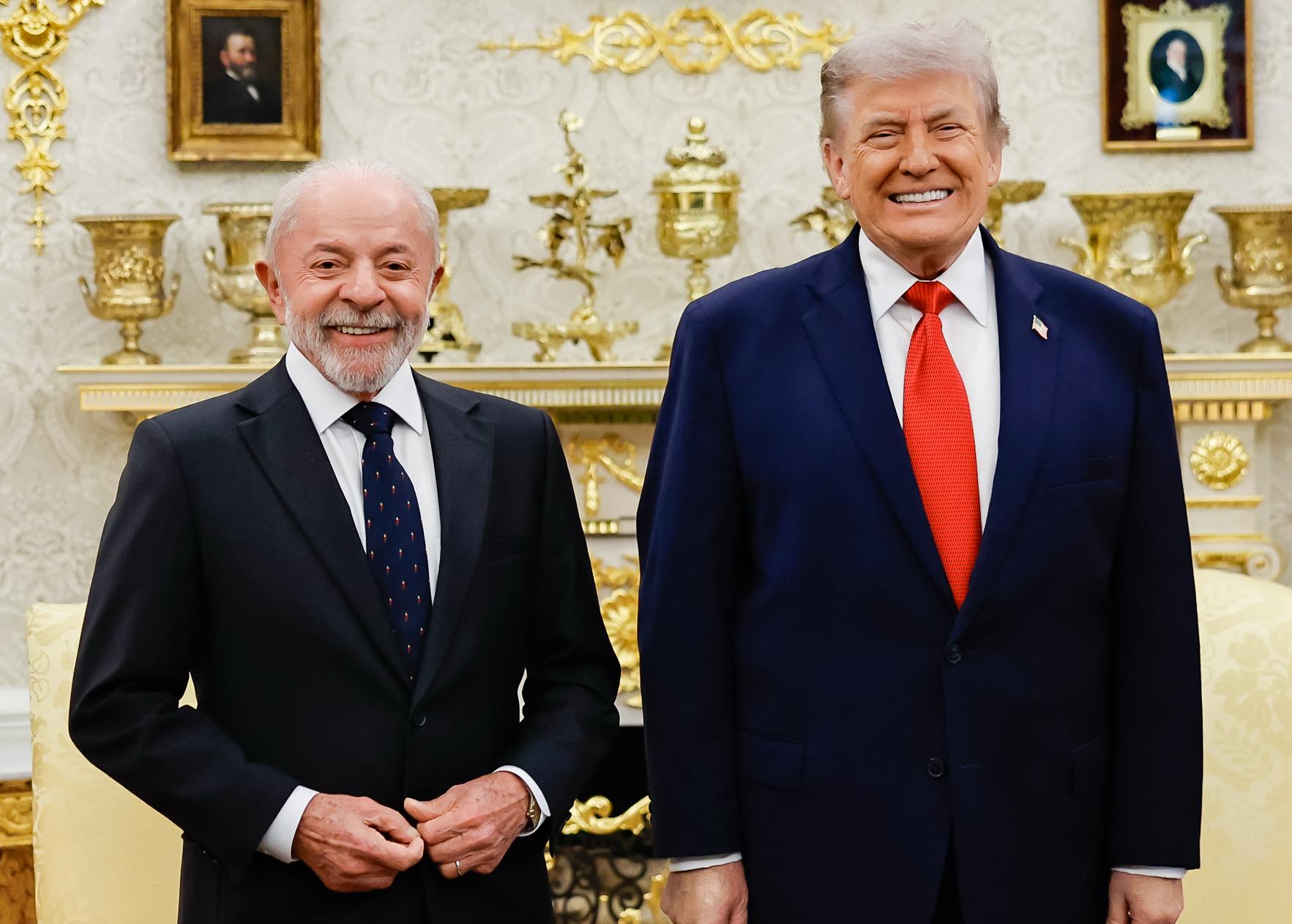
One name that will not appear on any ballot has become central to the campaign. US President Donald Trump was a close ally of Jair Bolsonaro and last year imposed a 50% tariff on Brazilian imports, citing, among other grievances, Brazil’s prosecution of the former president. He has not formally endorsed Flávio Bolsonaro, but he said on the eve of the vote that Washington was “watching that election very closely.”
That interest has become a flashpoint. Brazil temporarily suspended consular services in the country two days before voting, and police carried out searches linked to suspected threats against US diplomatic sites, although authorities said no evidence of a threat had been found at the time. Lula has framed the election as a test of sovereignty and warned against meddling; Brazil’s attorney general, Jorge Messias, said after a Guardian report on alleged Trump funding plans that foreign interference “cannot be tolerated.”
Flávio Bolsonaro has moved in the opposite direction. He visited the White House and the State Department during the campaign, presents closer ties with Washington as a foreign-policy selling point, and has promised to join “Shield of the Americas,” the US-led anti-crime coalition. He has also offered Brazil’s rare-earth and critical-mineral deposits as a way to help the United States reduce its dependence on China, an offer Lula has rejected.
The Guardian reports that analysts see Brazil as perhaps the last major country in the region still able to resist US pressure, after the operation that captured Venezuela’s Nicolás Maduro and a run of regional victories for candidates aligned with Trump. A Bolsonaro win, one Brazilian analyst told the newspaper, would be “a major boost to the far-right agenda globally.”
Scandals, betting and the economy
The race has been unsettled by a corruption scandal with no parallel in recent Brazilian elections. Flávio Bolsonaro is under investigation over the financing of Dark Horse, a biopic about his father, after leaked recordings showed him asking the jailed banker Daniel Vorcaro to bankroll the project. Vorcaro is accused of orchestrating one of Brazil’s largest financial fraud cases. Flávio Bolsonaro has acknowledged making the request.
The scandal has cut both ways. A police report suggested Vorcaro had contacts with a phone number linked to Supreme Court Justice Alexandre de Moraes, who presided over Jair Bolsonaro’s coup trial. Moraes has denied wrongdoing, but the revelations drew attention to the judge in the final weeks. Lula has sought to distance himself, saying “no one is above the law.”
Cost-of-living pressures and public security remain the issues voters cite most. Days before the vote, Lula banned fixed-odds sports betting, calling the industry a “cancer,” after critics linked it to rising household debt. The move followed a debate about whether the unregulated betting boom under Jair Bolsonaro had worsened household finances.
What is still uncertain
No result has been declared. The TSE is expected to begin releasing counts after polls close at 5pm Brasília time, which is 1am on 5 October in Pakistan. Given opinion-poll margins, the first round may not produce a winner, in which case the contest will be decided in the 25 October run-off.
Three uncertainties stand out. First, turnout and the size of the undecided and protest vote, which polling aggregators put at roughly 9% in the final days, could confound the pre-election surveys. Second, whether Flávio Bolsonaro would accept a narrow defeat: he has echoed his father’s unsubstantiated claims about the reliability of Brazil’s electronic voting system, which analysts told Al Jazeera could be groundwork to contest the result if he loses. Third, what a Bolsonaro victory would mean for Brazilian foreign policy, given the differing positions on the United States, tariffs and critical minerals.
This article will be updated, or followed by a separate report, once results are declared.
Sources & reporting notes
This is a synthesis of published material, not eyewitness reporting. Sources were reviewed on 4 October 2026. No first-round result had been declared at the time of writing, so all candidate standings rest on pre-election polling and campaign reporting rather than the official count.
- BBC News — "What to know about Brazil's election pitting Lula against Flávio Bolsonaro"4 October 2026 · Candidate profiles, poll tracker and undecided-voter estimate, the run-off threshold, the Bolsonaro coup conviction and the AI avatar, and the corruption and film-financing allegations.
- Al Jazeera English — "Brazil's Lula and Bolsonaro close campaigns ahead of critical election"4 October 2026 · Closing rallies in São Paulo and Rio de Janeiro, the tightening polls, Trump's "watching closely" remark, the film-funding investigation and the electronic-voting claims.
- Geo News — "Brazil votes for its next president on Sunday: How is Trump a major player in election?"4 October 2026 · The 50% US tariff on Brazilian imports, the suspension of consular services and the security searches, and the Trump–Bolsonaro family ties.
- The Guardian — "Brazil's neck-and-neck election offers test for growing pro-Trump Latin American bloc"3 October 2026 · Regional context, analyst assessments of Brazil's weight within Latin America, Lula's economic record, the critical-minerals dispute and the online-betting ban.