Reporting snapshot · 14 October 2026 (Asia/Karachi). This account rests on Pakistan's official records from the 13 October meetings and on same-day reporting by Dawn and The Express Tribune. The European Commission had not published its own readout when this article was written, and no agreement, memorandum or joint communiqué was announced. Figures the Pakistani side attributed to EU data have not been independently inspected by KhabarWire.
What happened
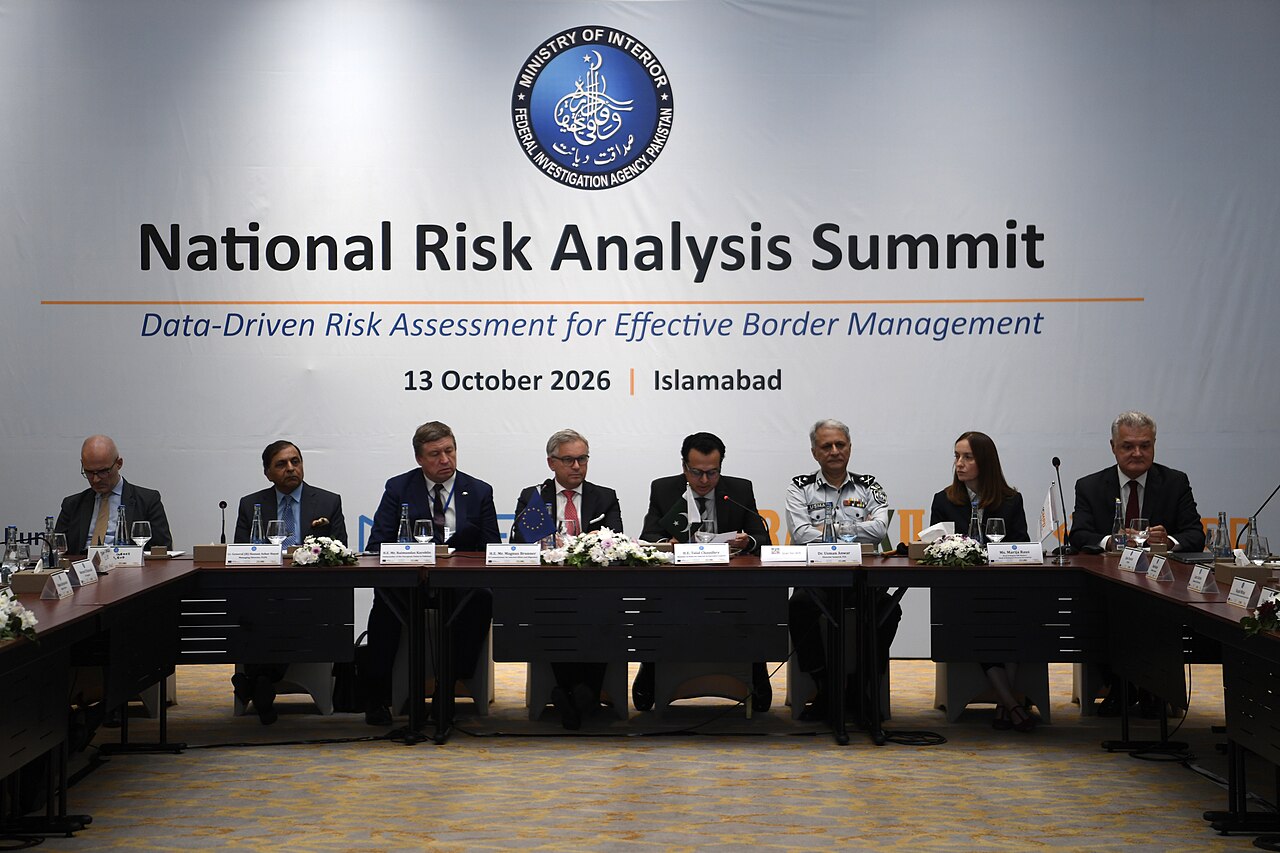
European Union Commissioner for Internal Affairs and Migration Magnus Brunner met Prime Minister Shehbaz Sharif in Islamabad on 13 October, opening a day of talks with Pakistan’s top civilian leadership on migration and mobility. It was Brunner’s first visit to Pakistan, the Prime Minister’s Office said in a press release issued the same day.
The PMO said the meeting focused on migration and mobility, one of the eight pillars of the Pakistan–EU Strategic Engagement Plan 2019. Shehbaz welcomed Brunner and said Pakistan attached importance to its partnership with the bloc, and reaffirmed its commitment to cooperation across all pillars of the plan. He highlighted Pakistan’s efforts to curb irregular migration and combat migrant smuggling and human trafficking through legislative reform, institutional strengthening, enforcement and international cooperation, and argued those efforts should be complemented by “practical opportunities for safe, orderly and regular migration”.
The prime minister said expanding legal pathways for Pakistani skilled workers and professionals would help meet European labour-market needs while reducing the vulnerability of would-be migrants to smuggling networks. Brunner, the PMO said, appreciated the measures Pakistan had taken and expressed confidence they would contribute to expanding legal migration pathways and “mutually beneficial labour mobility”.
The visit was wider than a single meeting. Brunner also called on President Asif Ali Zardari at Aiwan-e-Sadr and held separate talks with Deputy Prime Minister and Foreign Minister Ishaq Dar and Interior Minister Mohsin Naqvi, Dawn and The Express Tribune reported. He was accompanied by EU Ambassador to Pakistan Raimundas Karoblis, the European Commission’s director for migration and home affairs, Henrik Nielsen, and a member of his cabinet, Grigorios Delavekouras. On the Pakistani side, Interior Minister Mohsin Naqvi, Minister of State for Interior Talal Chaudhry and senators Sherry Rehman and Saleem Mandviwalla took part, along with former federal minister Naveed Qamar.
What each side asked for
Pakistan’s requests were framed around turning a fall in irregular departures into formal mobility. President Zardari said Pakistan continues to implement the EU Readmission Agreement and had readmitted more than 30,000 people over the years, and that EU figures showed irregular migration from Pakistan had fallen by 64 per cent in 18 months — which, he said, made Pakistan the only country in the region to record such a reduction, according to Dawn’s account of the presidency’s statement.
On that basis, Zardari called for “expanded legal pathways, skills-based mobility and structured cooperation”. He welcomed the expansion of the EU’s Talent Partnerships framework and asked for greater opportunities for skilled workers, including through circular migration. He said Pakistan wanted a structured mechanism to match its workforce with European labour-market requirements and hoped the EU would consider opening a European Legal Gateway Office in Pakistan. He also sought EU support to strengthen the capacity of the Pakistan Coast Guard and the Federal Investigation Agency (FIA) against smuggling.
Interior Minister Naqvi described a zero-tolerance policy on irregular migration and said that, after the 64 per cent reduction, Pakistan’s next target was to eliminate it entirely. The two sides agreed to work together on the EU’s Eastern Corridor Initiative and to expand cooperation on border management and Coast Guard capacity, Dawn and The Express Tribune reported. Brunner praised the FIA’s performance “despite limited resources” and said the fall in irregular migration would help open pathways for legal migration. He also commended Pakistan’s role in what the presidency described as maintaining regional balance.
Why it matters
For Pakistan, the migration file is economic as much as diplomatic. Workers’ remittances — which reached $3.59 billion in September 2026, according to State Bank of Pakistan data — are a central source of foreign exchange, as KhabarWire reported. Legal pathways for skilled workers to Europe are therefore both a labour-market question and a balance-of-payments one.
The talks also sit inside a broader Pakistan–EU relationship under pressure on the trade side. Brussels has tied the renewal of Pakistan’s GSP+ trade preferences beyond 2027 to progress on human rights, labour standards and governance, KhabarWire reported. Migration cooperation is one of the channels through which the two sides manage that relationship, and Brunner’s visit put it near the top of the agenda.
Pakistan has pursued similar packages bilaterally. In June 2026, Interior Minister Naqvi and British minister Hamish Falconer agreed to expand cooperation on counterterrorism, illegal migration, police training and visa fraud, KhabarWire reported. The EU track is larger in scale, given that EU labour markets and the bloc’s readmission framework cover far more Pakistani workers and returnees.
What is still uncertain
Several things remain unresolved. No agreement, memorandum of understanding or joint communiqué was announced, and the European Commission had not published its own readout of the visit when this article was written; the account above therefore rests mainly on Pakistani official statements and on reporting by Dawn and The Express Tribune.
Second, the headline numbers are attributed to EU data relayed by Pakistan’s presidency. The 64 per cent fall in irregular migration over 18 months, and the figure of more than 30,000 people readmitted, are not accompanied by a published dataset, and the readmission total covers multiple years rather than a single period.
Third, the proposal for a European Legal Gateway Office is a request, not a decision. No timetable or EU response was announced, and it is unclear whether Brussels will take it up. Pakistan said the next round of the Pakistan–EU Migration and Mobility Dialogue is expected in Brussels early next year; that timing is also unconfirmed.
Finally, readmission and returns raise consular and rights questions that a single visit does not settle, and the meeting did not change the separate GSP+ review timetable. Whether the visit produces a standing mechanism or only an exchange of intentions will depend on follow-up that has not yet been scheduled.
Sources & reporting notes
This is a synthesis of published material and official statements, not eyewitness reporting. The prime minister's account comes from the Press Information Department's official press release. The president's and interior minister's remarks, the readmission and migration figures and the list of participants come from Dawn's report. The Express Tribune's report of the same meetings corroborates the framework and the readmission figures. Background on remittances, GSP+ and earlier migration cooperation is drawn from the KhabarWire articles linked above. Sources were reviewed on 14 October 2026 (Asia/Karachi).
- Primary source — Press Information Department, Government of Pakistan: PR No. 163, 13 October 2026Published 13 October 2026 · The official record of Commissioner Brunner's call on Prime Minister Shehbaz Sharif, the migration-and-mobility pillar of the Pakistan–EU Strategic Engagement Plan 2019, and the prime minister's call for safe, orderly and regular migration.
- Independent source — Dawn: "PM Shehbaz, EU official discuss Pakistan's efforts to curb migrant smuggling"Published 13 October 2026 · The readmission agreement and more than 30,000 readmissions, the 64 per cent fall in irregular migration, the president's call for a European Legal Gateway Office and Talent Partnerships, and the interior minister's zero-tolerance stance and the Eastern Corridor Initiative.
- Independent source — The Express Tribune (APP): "PM Shehbaz emphasises need for 'safe, orderly migration' in meeting with EU commissioner"Published 13 October 2026 · Corroborates the PMO statement, the meetings with the president, foreign and interior ministers, Brunner's praise for the FIA, and the agreed focus on legal migration, border security and Coast Guard capacity.
.jpg)