Reporting snapshot · 1 October 2026. Pakistan beat Bangladesh in the first semi-final of the Asian Games men's cricket competition at Korogi Sports Park in Nisshin, Japan, on Thursday, 1 October. Later the same day, India beat Sri Lanka in the second semi-final, so the two neighbours will meet in Saturday's gold-medal match. This is a dated snapshot based on the official scorecard and match report carried by ESPNcricinfo and on independent reports by Geo News and Agence France-Presse, published by The Express Tribune. Rain reduced the match, and one partnership figure in the earliest reports was corrected by the fuller scorecard, as noted below.
What happened
Pakistan reached the men’s cricket final at the Asian Games for the first time after beating Bangladesh by six wickets in the first semi-final on Thursday. The match at Korogi Sports Park in Nisshin was reduced to 13 overs a side because of a wet outfield, and Pakistan chased down a revised target of 112 with nine balls to spare, finishing on 112 for four in 11.3 overs.
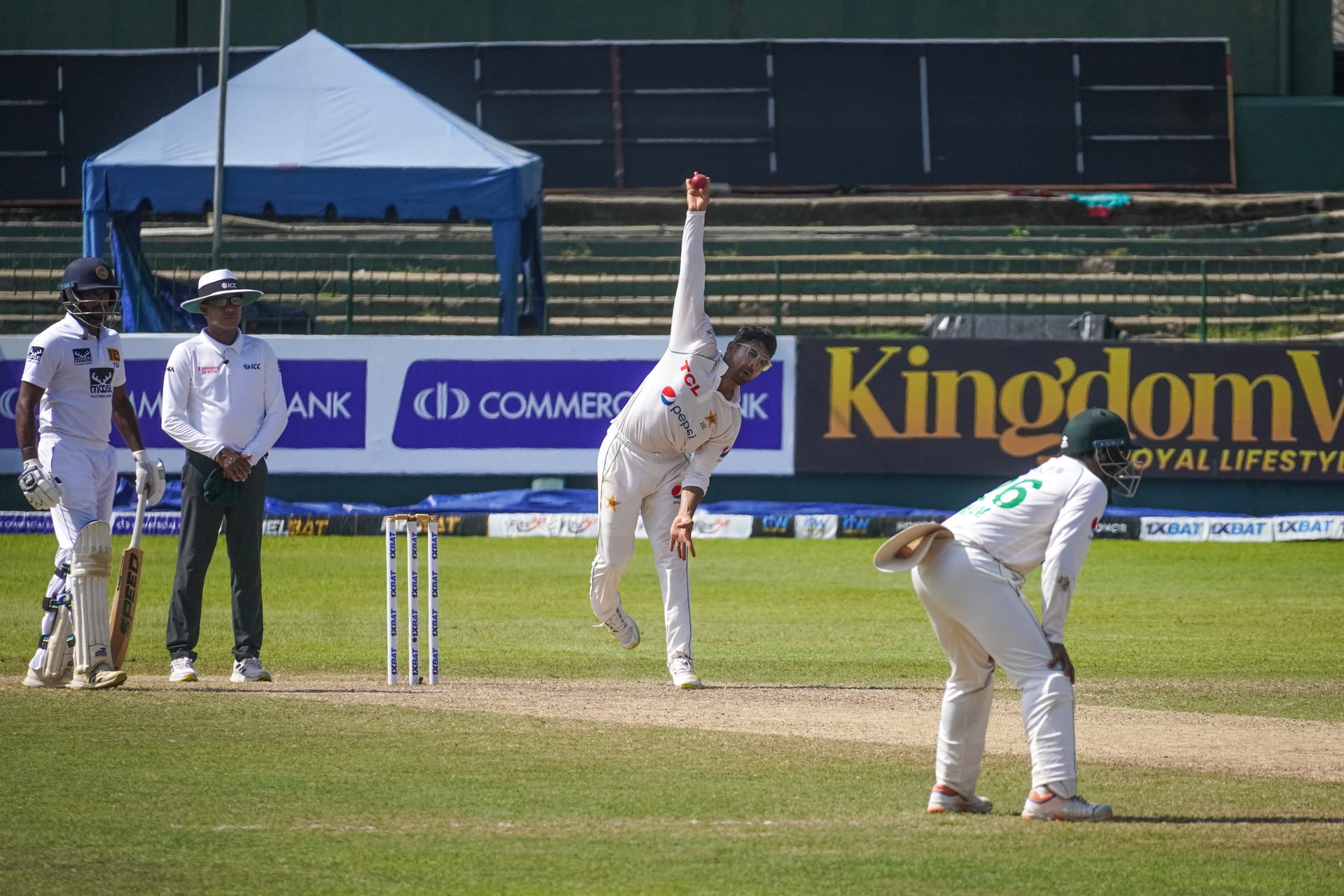
Captain Sahibzada Farhan won the toss and chose to field. Bangladesh made 111 for seven from their 13 overs, with Towhid Hridoy top-scoring with 42 off 25 balls, including four sixes and two fours, and opener Saif Hassan adding 19. Pakistan’s left-arm spinner Sufyan Moqim took three wickets for 26 runs, Arafat Minhas claimed two for 23, and Saim Ayub took one wicket for three runs from his two overs, according to the ESPNcricinfo scorecard and The Express Tribune’s report for Agence France-Presse.
Pakistan’s reply began badly. Farhan fell for one in the first over, and the innings slipped to 53 for four in the seventh when Usman Khan was dismissed. Maaz Sadaqat made 15 off seven balls and Saim Ayub struck 21 off 12, but neither could convert a start. From there, Abdul Samad and Hasan Nawaz turned the game. Their unbroken fifth-wicket stand was worth 59 runs, matching the difference between Pakistan’s total and the score at the fall of the fourth wicket, and both finished unbeaten.
Samad, who came in at number six, made 30 not out from 15 balls with five fours and a six. His decisive passage came in the 10th over against the experienced seamer Mustafizur Rahman, when he took 22 runs from five deliveries. Hasan Nawaz finished 27 not out from 22 balls. The win sent Pakistan into the gold-medal match, where they will face India.
How Pakistan won the chase
The semi-final was decided by the contrast between Pakistan’s start and their finish. Bangladesh’s bowlers removed both openers and then Usman Khan, leaving a young middle order to rebuild a chase that had looked awkward on a slow, damp surface. Samad’s acceleration shifted the required rate at the point when Bangladesh were still favourites, and Nawaz’s support meant the innings did not depend on a single cameo.
Pakistan’s bowling had already kept Bangladesh to a modest total. Moqim’s three wickets and Minhas’s two came as Bangladesh lost momentum after a bright start, though Pakistan’s discipline was not perfect: ESPNcricinfo recorded 19 extras, 15 of them wides. Hridoy’s 42 off 25 was the innings’ anchor, and his partnership of 53 with Mosaddek Hossain briefly threatened a larger total before Pakistan’s spinners and seamers reasserted control in the closing overs.
The result is a significant step for a Pakistan squad that arrived at the Games without several senior players and with head coach Mike Hesson framing the tournament as a chance to blood younger cricketers and give Farhan captaincy experience. The side had reached the last four without playing a ball, advancing on a ranking rule when their quarter-final against Hong Kong was washed out on 28 September. Against Bangladesh they finally had to win a match to stay in the tournament, and did so under pressure.
India await in the gold-medal match
The second semi-final in Nisshin eliminated any uncertainty about the opponent. India beat Sri Lanka by 124 runs, scoring 169 for seven and then bowling Sri Lanka out for 45 in 9.5 overs. Ishan Kishan top-scored for India with 80 not out from 46 balls. Jasprit Bumrah took two wickets for seven runs, Axar Patel two for eight, and Abhishek Sharma two for two, per the ESPNcricinfo scorecard.
That result sets up a Pakistan-India final on Saturday, 3 October, at the same venue. The pairing has become the tournament’s central storyline. Because Pakistan and India were placed in opposite halves of the draw, they could only meet in a medal match, and their progress was itself shaped by weather: all four quarter-finals were abandoned without a ball bowled, and both semi-finals were played under the threat of further rain.
Why the final matters
Pakistan have never won a medal in the men’s cricket competition at the Asian Games. They lost the bronze-medal match in 2010 and again in 2023 and did not compete in 2014, according to Agence France-Presse, so reaching Saturday’s final guarantees at least a first men’s cricket medal of some colour. It follows the women’s team’s bronze earlier in these Games and continues a productive tournament for Pakistan across several sports.
An India final also carries a wider competitive context. Hesson had described India as “the benchmark in white-ball cricket”, and since taking charge in May 2025 he has overseen a series of defeats to them at the Asia Cup and the T20 World Cup. Pakistan began this campaign as underdogs against the defending men’s champions, and Saturday will test how far a second-string but improving side has closed the gap. India’s one-sided win over Sri Lanka underlines the scale of the task.
What is still uncertain
The most immediate unknown is the weather. The men’s cricket competition has already been reshaped by rain, with the quarter-finals abandoned and Thursday’s first semi-final shortened to 13 overs a side; a washout in the final would raise harder questions about reserve days and shared medals that organisers have not addressed publicly. The final’s playing conditions have not been spelled out in the coverage reviewed.
It is also unclear how representative Pakistan’s semi-final performance is of their form. Their top order struggled before Samad and Nawaz rescued the chase, and India’s bowlers present a sharper test than Bangladesh’s. The scorecard and match report are the official record of the match, but the detail here rests on ESPNcricinfo’s reporting and independent agency and news accounts, not on eyewitness reporting by KhabarWire. Any change to the final’s schedule or format would supersede the picture above.
Sources & reporting notes
This is a synthesis of published material, not eyewitness reporting. Sources were reviewed on 1 October 2026. The match scorecard and innings details come from ESPNcricinfo; independent confirmation of the result, the totals and the decisive over come from Geo News and Agence France-Presse, published by The Express Tribune. The scoreline for the second semi-final, which decided Pakistan's opponent, comes from the ESPNcricinfo scorecard.
- ESPNcricinfo — Samad special books Pakistan's spot in gold-medal clash1 October 2026 · Official scorecard and match report: the 13-over format, Bangladesh's 111 for seven, Pakistan's 112 for four in 11.3 overs, Samad's 30 not out and Nawaz's 27 not out, the 59-run stand, the 19 extras and the innings detail.
- Geo News — Pakistan beat Bangladesh by six wickets to reach Asian Games cricket final1 October 2026 · Independent report of the toss, both innings, the individual scores and the bowling figures for Moqim and Minhas.
- The Express Tribune / Agence France-Presse — Samad's stunning knock sends Pakistan into Asian Games final1 October 2026 · Independent wire report confirming the six-wicket win, the 59-run unbroken stand, Samad's 22 runs from five deliveries in the 10th over, and the final's Saturday date against the winner of India versus Sri Lanka.
- ESPNcricinfo — India vs Sri Lanka, 2nd semi-final, full scorecard1 October 2026 · Scorecard for India's 124-run win (India 169 for seven; Sri Lanka 45), which confirmed that Pakistan will face India in the gold-medal match.